
Screw & Barrel Maintenance Guide for PVC Extruders
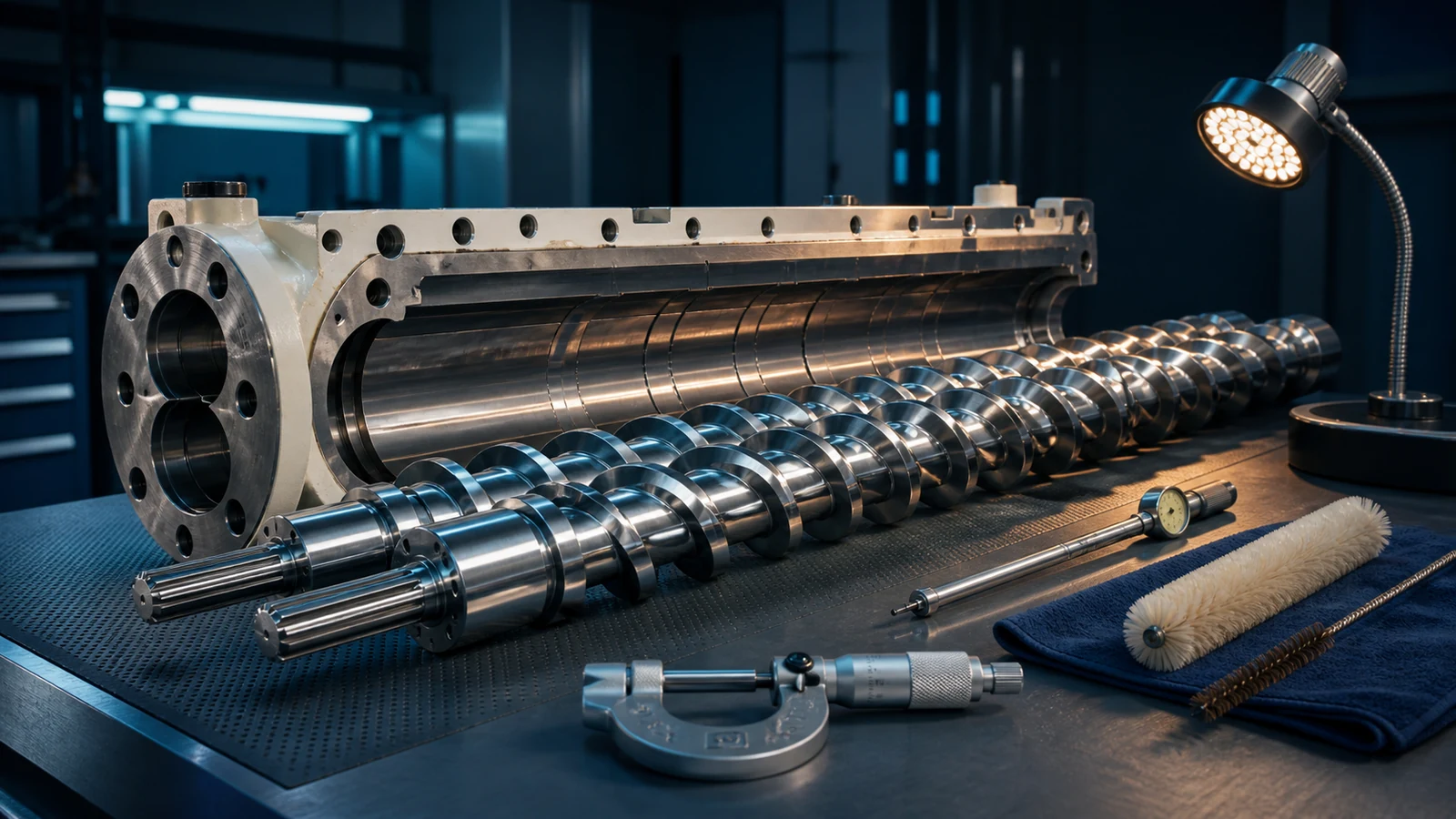
The screw and barrel are the heart of any extrusion line—and one of the most expensive assemblies to replace. A new screw-barrel set for a conical twin-screw extruder (SJZ 65/132) costs US$15,000–25,000. With proper maintenance, this set should last 3–5 years processing standard rigid PVC and 5–8 years with gentle formulations. With poor maintenance, you'll be replacing it in 18 months.
This guide covers wear mechanisms, measurement techniques, maintenance procedures, and the critical "rebuild vs. replace" decision for PVC extruder screws and barrels used in profile, sheet, and WPC production.
1. How Screws and Barrels Wear: The Three Mechanisms
Mechanism 1: Abrasive Wear
This is the dominant wear mechanism in PVC extrusion. Hard particles in the compound—CaCO3 filler, TiO2 pigment, silica impurities in CaCO3, and wood particles in WPC—act as microscopic cutting tools, eroding both screw flight tips and barrel wall. Abrasive wear rate is proportional to:
- Filler content (each 10 phr CaCO3 above 20 phr roughly doubles wear rate)
- Filler particle size (larger particles = faster wear)
- Filler hardness (silica in low-grade CaCO3 is particularly damaging)
- Screw speed (higher RPM = higher relative velocity = more abrasion per unit time)
Mechanism 2: Corrosive Wear
HCl liberated during PVC degradation attacks the metal surfaces of both screw and barrel. Even with proper stabilization, trace HCl is always present. Poor temperature control or formulation errors that cause even mild degradation dramatically accelerate corrosive attack. Corrosion appears as pitting (small craters) rather than the smooth polished appearance of abrasive wear.
Mechanism 3: Adhesive Wear
At high temperatures and pressures, microscopic metal-to-metal contact between screw flights and barrel wall can cause galling—localized welding and tearing of metal surfaces. This is most common during startup when full melt lubrication has not yet been established, or when the screw is run dry.
Most screw/barrel failures are a combination of all three mechanisms. Abrasive wear from CaCO3 creates micro-grooves; HCl corrosion attacks the freshly exposed metal in those grooves; and the roughened surface promotes adhesive galling. This is why screw life drops non-linearly as filler content increases.
2. Wear Measurement: How to Know When It's Time
Key Clearances to Measure
| Measurement | New (Typical SJZ 65/132) | Service Limit | Replace At |
|---|---|---|---|
| Screw flight-to-barrel radial clearance | 0.15–0.25 mm (per side) | 0.40–0.50 mm | 0.55–0.65 mm |
| Screw intermesh clearance (twin) | 0.20–0.35 mm | 0.60–0.80 mm | >1.0 mm |
| Barrel bore diameter increase | 0 (reference) | +0.30–0.40 mm | +0.50–0.70 mm |
How to Measure
- Feeler gauge method (in-field): Insert feeler gauge between screw flight tip and barrel wall at multiple circumferential positions. This gives radial clearance directly. Do this at 3–5 positions along the screw length.
- Bore gauge method (workshop): Measure the barrel bore ID with an internal micrometer or bore gauge at multiple axial positions. Compare to original specification. A 0.5 mm increase in bore diameter indicates significant wear.
- Output test (indirect): Measure extruder output (kg/hr) at a fixed screw RPM and compare to the benchmark when new. A 10–15% output reduction at the same RPM indicates significant wear (increased back-flow between screw and barrel).
- Motor load signature (indirect): As clearance increases, the screw "slips" more, motor load decreases, and melt temperature drops (less shear work). A sustained 10% drop in motor amperage at fixed RPM and formulation indicates wear.
Measure and record clearances every 3 months. The trend is more important than any single measurement. A sudden increase in wear rate (0.05 mm/month vs. the normal 0.01–0.02 mm/month) indicates a problem: contaminated material, processing temperature excursion, or loss of nitrided layer.
3. Surface Protection Technologies
Nitriding (Standard Protection)
Most PVC extruder screws and barrels are gas-nitrided. Nitrogen diffuses into the steel surface at 500–550°C, forming a hard iron nitride case (0.3–0.5 mm deep, 900–1,100 HV hardness). Nitriding provides good general wear and corrosion resistance for standard PVC formulations with low-to-moderate filler (<30 phr CaCO3).
Service life with nitriding: 3–5 years for standard PVC profiles; 1–2 years for WPC or SPC (high wood/filler content).
Bimetallic Barrel (Premium Protection)
A bimetallic barrel has a centrifugally cast wear-resistant alloy liner (typically Fe-Cr-B or Ni-Cr-B based, 60–65 HRC) metallurgically bonded to the steel barrel body. The liner is 1.5–3.0 mm thick and provides 3–5x longer life than nitrided barrels in abrasive applications.
Mandatory for: SPC flooring extrusion (CaCO3 >200 phr), WPC extrusion (wood flour), and any line running >30 phr CaCO3 at >20 RPM continuously.
Cost adder: US$10,000–15,000 over nitrided barrel, but extends barrel life from 1–2 years to 4–7 years in abrasive service, providing a strong ROI.
Hard Chrome Plating (Screw Flights)
Hard chrome plating (0.05–0.10 mm thick, 900–1,000 HV) on screw flight tips provides additional wear resistance at the most highly stressed contact point. Chrome plating is typically applied over a nitrided substrate. For highly abrasive service, tungsten carbide or Stellite hardfacing on the flight tips can extend screw life by 2–3x.
4. Preventive Maintenance Schedule
| Interval | Action | Details |
|---|---|---|
| Daily | Visual check of screw tip/extrudate quality | Look for black specks (degraded material from worn clearances), surging, or output drop—all indirect signs of wear |
| Weekly | Motor load trend review | Plot motor amperage at fixed RPM and formulation. A sustained downward trend indicates increasing clearance |
| Monthly | Output test | Run at fixed RPM for 15 min, weigh output, calculate kg/hr. Compare to benchmark. Record trend. |
| Quarterly | Clearance measurement (feeler gauge) | Measure radial clearance at 3–5 positions. Record in maintenance log. Calculate wear rate in mm/month. |
| Annually | Pull screw for inspection | Remove screw, clean, inspect for corrosion pitting, galling, wear pattern. Measure flight OD at multiple positions with micrometer. Bore-gauge barrel. |
| Every 2–3 years (or when wear limit reached) | Rebuild or replace screw/barrel | Based on clearance measurements. Plan ahead—lead time for a new screw-barrel set is 4–8 weeks. |
5. Screw Cleaning: Right Way vs Wrong Way
Proper Cleaning Method: Purging Compound
- At shutdown, stop PVC feed and run the screw at 10–15 RPM
- Feed purging compound (cast acrylic or commercial PVC purge grade) at the normal feed rate
- When purge compound exits the die cleanly (2–3 kg purge for SJZ 65/132), stop feed
- Run screw until no more material exits the die
- Reduce all temperatures to 130–140°C, stop screw, turn off heaters
DO NOT Do These Things
- DO NOT use a cutting torch to burn off PVC residue. Localized heating above 500°C destroys the nitrided case and warps the screw. This is the most common cause of premature screw failure.
- DO NOT use steel scrapers, chisels, or wire brushes on nitrided surfaces. The nitrided case is only 0.3–0.5 mm deep. Scratching through it exposes soft base metal that will wear rapidly.
- DO NOT sandblast screws with silica sand. Use only plastic media (acrylic, walnut shell) or soda blasting. Silica sand erodes the nitrided layer.
- DO NOT cool a hot screw rapidly (water quench). Thermal shock can crack the nitrided case. Allow the screw to cool naturally in air to below 50°C before any wet cleaning.
Screw Storage
- Store cleaned screws vertically (hanging) or horizontally on V-blocks with support every 1.5 meters
- Coat with rust-preventive oil (not grease—grease traps moisture)
- Wrap in VCI (Volatile Corrosion Inhibitor) paper or plastic
- Store in a dry area (<50% RH), temperature above dew point
6. Rebuild vs Replace: The Decision Matrix
| Condition | Action | Cost (SJZ 65/132) | Result |
|---|---|---|---|
| Flight clearance <0.35 mm; no corrosion; nitrided case intact | No action needed; continue monitoring | US$0 | Good for 1–2 more years |
| Flight clearance 0.40–0.55 mm; nitrided case worn but base metal intact; no barrel scoring | Rebuild screw (re-nitride flights, re-chrome) | US$3,000–6,000 | Restored to ~90% of new performance; 2–3 year additional life |
| Flight clearance >0.55 mm; visible pitting/corrosion; barrel scored | Rebuild screw AND re-sleeve or replace barrel | US$8,000–15,000 | Restored to ~85–90% of new performance |
| Flight clearance >0.65 mm; severe pitting; barrel bore increase >0.5 mm; screw geometry visibly eroded | Replace screw and barrel as a set | US$15,000–25,000 | Restored to new performance; 3–5 year life (standard PVC) |
Decision rule: If the rebuild cost exceeds 60% of the replacement cost, replace. The remaining 40% buys a full design life rather than a reduced-life rebuild. Also, if the barrel is scored (axial grooves visible by borescope), replacing only the screw will accelerate wear of the new screw against the damaged barrel—always address screw and barrel as a system.
7. Formulation Factors That Affect Screw Life
| Formulation Factor | Impact on Screw/Barrel Life | Mitigation |
|---|---|---|
| CaCO3 >30 phr | Life reduced by 40–60% (to 1.5–2.5 years) | Use bimetallic barrel; hardfacing on screw flights; finer CaCO3 (1250 mesh) |
| WPC (wood flour in PVC) | Life reduced by 50–70% (to 1–2 years) | Bimetallic barrel mandatory; 40Cr or 42CrMo screws with Cr-Mo-V nitriding; use finer wood powder (<80 mesh) |
| SPC (CaCO3 >200 phr) | Life reduced by 70–80% (to 0.5–1.5 years) | Premium bimetallic barrel + tungsten carbide hardfaced screws mandatory; budget for annual screw replacement |
| CaCO3 with high silica (>2%) | Life reduced by 30–50% at same loading | Specify low-silica (<1%) CaCO3; pay slight premium for clean filler |
| Recycled/reclaimed PVC | Variable; metallic contamination (nails, staples) can cause catastrophic damage | Install magnetic separators and metal detectors on regrind feed stream |
Need Screw or Barrel Service?
We supply OEM and aftermarket screws and barrels for all major twin-screw extruder brands, plus in-house nitriding and chrome plating services.
Request Service QuoteRelated Articles
- Conical vs Parallel Twin Screw Extruder
- PVC Calcium Carbonate Filler Guide
- PVC Extrusion Troubleshooting Guide
- Extrusion Line Energy Efficiency Optimization
Conclusion
Screw and barrel maintenance is not glamorous, but it directly determines your extrusion line's profitability. A worn screw-barrel set increases energy consumption (motor works harder against greater clearance), reduces output (back-flow increases), degrades product quality (poor mixing, lower melt temperature), and eventually causes catastrophic failure. The maintenance essentials: measure clearances quarterly and track the trend, use the correct purging compound at every shutdown, never use destructive cleaning methods, and plan for rebuild/replacement before the wear limit is reached—not after production quality has already been compromised.