
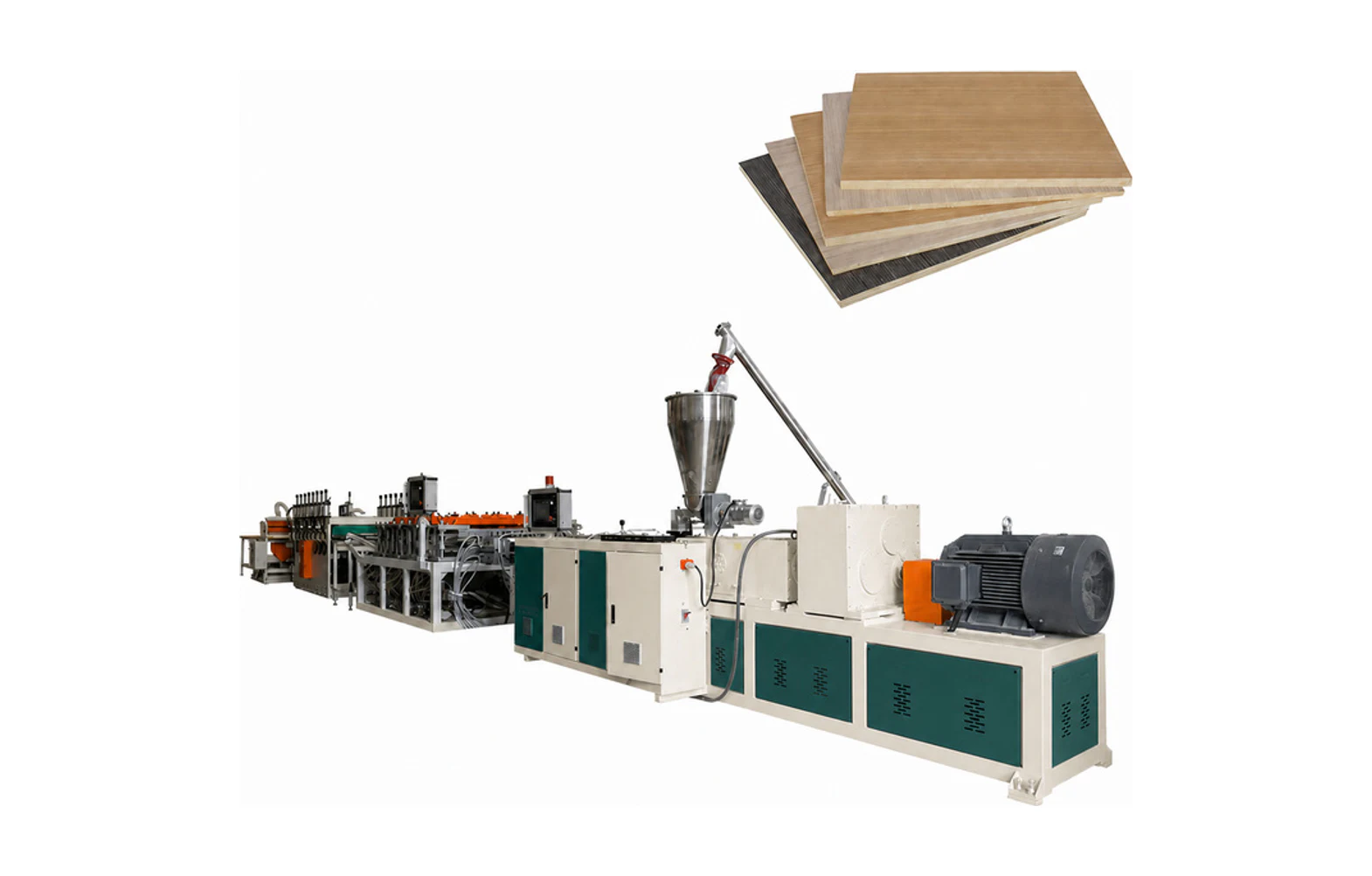
WPC Foam Board Machine
Product Overview
The WPC Foam Board Machine combines wood-plastic composite technology with Celuka foaming to produce lightweight boards with a wood-like appearance and workability. These boards bridge the gap between PVC foam boards and MDF — offering water resistance, paintability, and screw retention that neither material alone provides.
The line features an SJSZ-92/188 conical twin-screw extruder, Celuka foam die with skin-forming technology, precision calender for thickness control, and stacking system. It produces boards 1220-1830mm wide and 5-20mm thick with 20-30% wood flour content and densities of 0.6-0.8 g/cm³.
WPC foam boards are positioned as premium furniture and cabinet materials. They combine the moisture resistance and fire retardancy of PVC foam boards with the screw retention and paintability of MDF — enabling furniture manufacturers to produce waterproof cabinetry that can be assembled with standard screws and hinges.
The Celuka foaming process creates a hard, smooth skin over a foamed wood-plastic core. This skin provides excellent paint adhesion and scratch resistance, while the foamed core reduces board weight by 30-40% compared to solid WPC of the same dimensions.
Key Features
Conical twin-screw extruder
Celuka foam die with skin-forming
Calender for thickness control
Online cooling and trimming
Stacking system
Production Process
From raw material to finished product — each step is engineered for quality and efficiency.
WPC Foam Compound
PVC resin, dried wood flour (20-30%), foaming agent, coupling agents, and stabilizers are mixed. The foaming agent controls density; coupling agents ensure wood-PVC bonding.
Extrusion & Celuka Die
The compound is processed at 160-180°C and extruded through a Celuka die that compresses the outer surface into a hard skin while the core foams.
Calender & Calibration
The foamed board passes through a precision calender that controls thickness and surface smoothness, followed by vacuum calibration for dimensional accuracy.
Cooling & Edge Trimming
Multi-zone cooling stabilizes the board. Edge trimmers remove foam overflow to create clean, straight edges suitable for panel joining.
Cutting & Stacking
A synchronized cutting saw trims boards to standard sizes (1220x2440mm, 1830x2440mm). An automatic stacker collects finished boards.
Quality Inspection
Boards are inspected for density, surface quality, skin thickness, and dimensional accuracy before packaging.
Technical Specifications
| Extruder Model | SJSZ-92/188 |
|---|---|
| Board Width | 1220mm - 1830mm |
| Board Thickness | 5mm - 20mm |
| Density | 0.6-0.8 g/cm³ |
| Production Speed | 1-2 m/min |
| Total Power | ~180-250 kW |
Why Choose Wings Plastic
Wood + Foam Hybrid
Combines wood fiber screw retention and paintability with PVC foam lightweight and moisture resistance — creating a premium material that outperforms both MDF and PVC foam board alone.
Celuka Hard Skin
The Celuka process creates a 0.3-0.5mm hard skin that provides scratch resistance, paint adhesion, and a smooth surface — superior to free-foam WPC boards.
Screw Retention
Wood fibers in the formulation provide screw withdrawal resistance of 120-180 N/mm — comparable to MDF and sufficient for furniture hinge and joint assembly.
Waterproof & Paintable
Unlike MDF, WPC foam boards are waterproof and won't swell in humid conditions. Unlike PVC foam board, they can be painted directly without primer.
Lightweight Advantage
At 0.6-0.8 g/cm³, WPC foam boards are 30-40% lighter than solid WPC and 20% lighter than MDF — reducing shipping costs and simplifying handling in furniture manufacturing.
Quality Assurance
Every production line undergoes rigorous quality verification before delivery:
- Board density verified by weight/volume measurement per batch
- Screw withdrawal resistance tested at multiple points per ASTM D1037
- Skin thickness and quality verified using cross-section microscopy
- Surface paint adhesion tested using cross-hatch method per ASTM D3359
Typical Applications
Frequently Asked Questions
WPC foam board is waterproof (MDF is not), lighter (0.7 vs 0.8 g/cm³), paintable without primer, and has comparable screw retention. However, MDF is less expensive and has a smoother surface for high-gloss finishes.
Yes, WPC foam boards are ideal for kitchen cabinets — they are waterproof, paintable, hold screws securely, and resist the humidity and temperature variations common in kitchens.
20-25% for maximum moisture resistance and lower density. 25-30% for better screw retention and more wood-like appearance. Above 30%, moisture absorption increases and density rises.
Yes, WPC foam boards can be CNC routed, drilled, and machined using standard woodworking tools. The material cuts cleanly without splintering and produces smooth edges.
Related Products
Related Technical Articles
Ready to Get Started?
Contact our team for a customized WPC Foam Board Machine solution tailored to your production needs.
Contact Us