
WPC Surface Treatment: Embossing, Sanding & Brushing
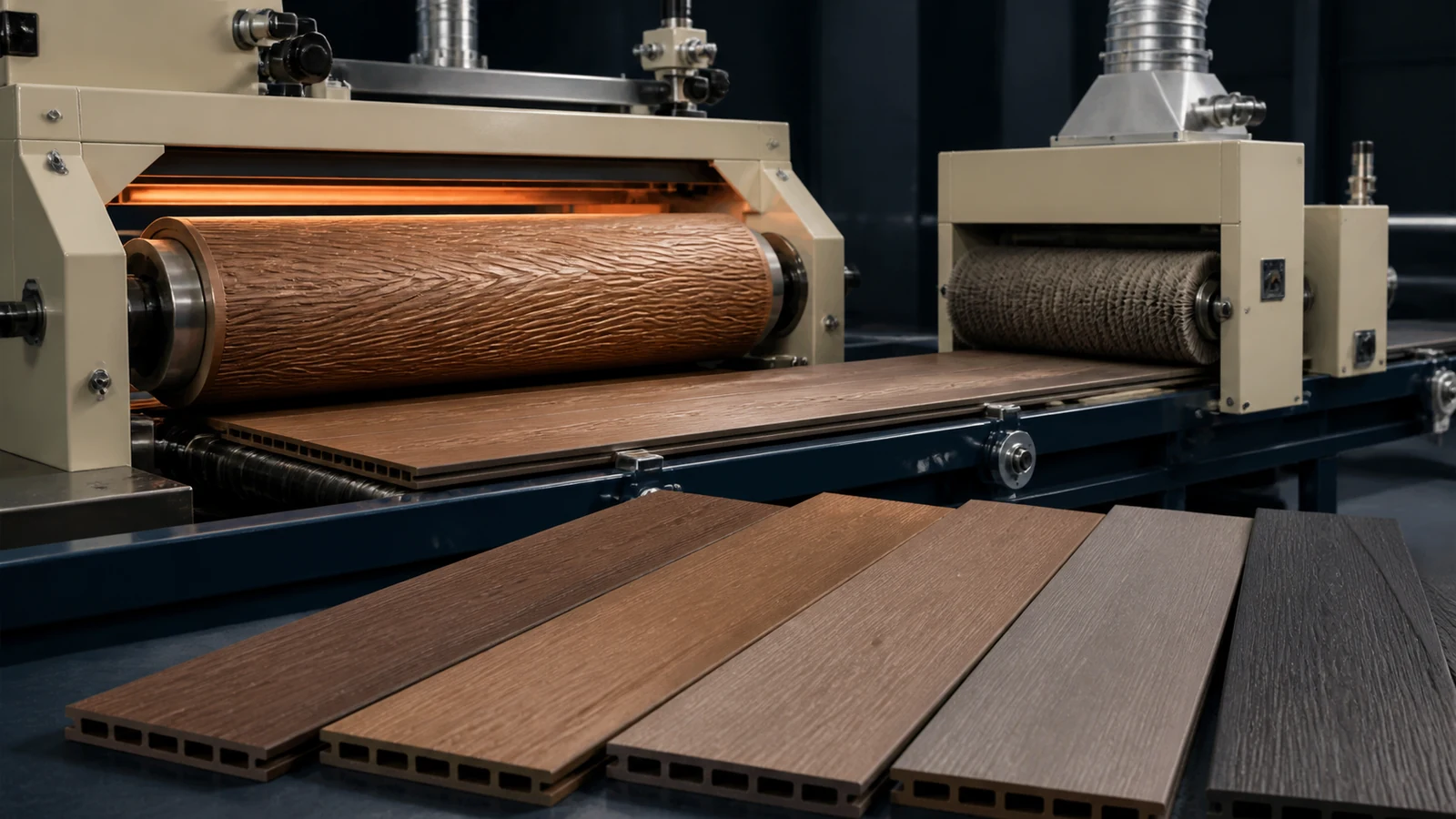
WPC (Wood-Plastic Composite) products sell on how convincingly they look and feel like real wood. The base extrusion gives you shape and color, but it is surface treatment that transforms a plastic-looking board into a wood-like decking or wall panel that end-users are willing to pay a premium for. This guide covers the three primary surface treatment processes—embossing, sanding, and brushing—and explains how to integrate them inline or offline with your WPC extrusion line.
1. Why Surface Treatment Matters for WPC
Extruded WPC profiles come out of the die with a smooth, plastic-like surface. Even with wood-colored masterbatch, the surface reads as "fake" to consumers. Surface treatment solves four problems simultaneously:
- Aesthetics: Creates realistic wood-grain texture and depth
- Slip resistance: Textured surfaces provide better grip (critical for outdoor decking)
- Scratch hiding: Textured surfaces conceal minor scratches better than smooth surfaces
- Perceived value: A well-textured WPC product can command 20–40% higher price than a smooth equivalent
2. Embossing (Hot), Precision, Degrees
Embossing is the most common WPC surface treatment and the only one that can be done fully inline during extrusion.
How It Works
An embossing roller (steel roller engraved with a negative wood-grain pattern) is mounted in the calibration/sizing section of the extrusion line, immediately after the die. The hot WPC profile (170–180°C at the surface) passes through the embossing roller under controlled pressure, and the pattern is permanently transferred to the surface before it cools and hardens.
Key Parameters
| Parameter | Recommended Range | Effect |
|---|---|---|
| Roller temperature | 120–150°C | Too cold: shallow embossing depth. Too hot: material sticks to roller. |
| Embossing pressure | 0.3–0.8 MPa (pneumatic) | Higher pressure = deeper grain. Excessive pressure distorts profile dimensions. |
| Line speed | 0.5–2.5 m/min | Slower speeds allow deeper embossing. Faster lines need multi-roller setups. |
| Pattern depth | 0.1–0.5 mm | 0.2–0.3 mm is optimal for realistic wood feel without weakening surface layer. |
| Profile surface temp | 170–185°C (at embossing point) | Must be above PVC Vicat softening point (~80°C) but below degradation (~195°C). |
Embossing Roller Design
The roller is typically chrome-plated hardened steel with a laser-engraved pattern. Key design considerations:
- Grain direction: For decking, a longitudinal grain pattern (parallel to extrusion direction) looks most natural. For wall panels, cross-grain or random patterns add variety.
- Pattern repeat length: Roller circumference should not be an exact divisor of common board lengths (to avoid visible pattern repetition). Use non-standard circumferences (ø200 mm, ø220 mm rather than ø250 mm).
- Release coating: PTFE (Teflon) coating on the roller surface prevents WPC from sticking. Re-coat every 3–6 months depending on production volume.
3. Sanding: Creating Realistic Wood Texture
Sanding is an offline (post-extrusion) process that creates the most authentic wood feel. It physically removes the surface polymer skin to expose the wood fibers beneath, creating a texture that feels like real wood because it partially is.
Sanding Process Steps
- Coarse sanding: 80–120 grit belt sander removes the polymer-rich surface layer (0.1–0.3 mm). This exposes wood fibers and creates the primary texture.
- Fine sanding: 180–240 grit to smooth out coarse sanding marks and create a uniform matte finish.
- Dust removal: High-pressure air blow or brush cleaner removes sanding dust from wood-grain crevices.
Sanding Configuration for WPC Profiles
| Product Type | Grit Sequence | Sanding Depth | Belt Speed | Feed Speed |
|---|---|---|---|---|
| WPC Decking | 100 → 180 → 240 | 0.15–0.25 mm | 12–18 m/s | 6–12 m/min |
| WPC Wall Panels | 120 → 220 | 0.10–0.15 mm | 10–15 m/s | 8–15 m/min |
| WPC Doors | 80 → 150 → 220 | 0.20–0.35 mm | 15–20 m/s | 4–8 m/min |
The key to sanding WPC is matching the wood powder particle size in the formulation. If your wood powder is 80–100 mesh, sanding with 100-grit creates the most natural texture. Finer wood powder (120–150 mesh) pairs with 180+ grit sanding for a smoother, satin feel.
4. Wire Brushing: Deep Wood-Grain Relief
Wire brushing goes a step beyond sanding. Rotating steel or nylon wire brushes aggressively remove the softer polymer component from the surface layer, leaving the harder wood particles standing in relief. This creates a deeply textured, weathered-wood appearance that is highly desirable for premium products.
Brushing vs Sanding
| Feature | Sanding | Wire Brushing |
|---|---|---|
| Material removal mechanism | Abrasive (cuts everything evenly) | Selective (removes polymer preferentially) |
| Final surface | Uniform matte texture | Deep relief, wood fibers standing proud |
| Depth of texture | 0.1–0.25 mm | 0.3–0.8 mm |
| Best for | Decking, wall panels | Premium decking, cladding, doors |
| Production speed impact | Minimal | Significant (slower process) |
| Cost adder | US$0.50–1.00/m2 | US$1.50–3.00/m2 |
Brush Selection
- Steel wire brushes (0.3–0.5 mm wire): Aggressive material removal, used for first-pass deep texturing. Risk: can leave metal marks on light-colored WPC.
- Nylon-abrasive brushes (with SiC or Al2O3 embedded): Gentler, no metal contamination, ideal for finishing pass. Use 80–120 grit embedded nylon brushes for WPC.
- Combination: Steel brush for the first station (deep relief), nylon-abrasive for the second station (smoothing). This is the standard setup for high-end WPC decking lines.
5. Thermal Treatment for Color Depth
Heat treatment (180–220°C for 30–90 seconds) after sanding or brushing creates a darker, richer color by partially caramelizing the surface wood fibers. This is the "secret sauce" that makes premium WPC decking look more like tropical hardwood. Infrared (IR) heaters or hot-air tunnels are used inline after the brushing station.
Caution: Overheating (>230°C) degrades the PVC component, causing yellowing and brittleness. Temperature must be precisely controlled with IR pyrometer feedback.
6. Inline vs Offline Surface Treatment
| Approach | Processes Possible | Advantages | Disadvantages |
|---|---|---|---|
| Inline (on extrusion line) | Embossing only | No extra handling; heat from extrusion aids embossing; lower labor cost | Limited to embossing; line speed constrained by embossing quality |
| Offline (separate station) | Sanding, brushing, thermal treatment, UV coating | Independent speed optimization; multiple treatments possible; higher quality | Extra handling, labor, and floor space; higher investment |
| Hybrid (inline embossing + offline finishing) | Embossing inline + sanding/brushing offline | Best of both worlds; embossing provides baseline texture, offline deepens it | Highest total investment |
For most manufacturers, the optimal setup is: inline embossing on the extrusion line followed by offline sanding or brushing only for premium product grades. This allows you to run standard and premium products from the same line.
7. Common Surface Treatment Defects
| Defect | Cause | Solution |
|---|---|---|
| Shallow embossing (faint grain) | Roller too cold; insufficient pressure; profile cooling too fast | Increase roller temp to 140–150°C; increase pressure; position embosser closer to die |
| Material sticking to embossing roller | Roller too hot; worn release coating; excessive external lubricant | Reduce roller temp; re-coat with PTFE; reduce external lubricant in formulation |
| Uneven sanding (stripes left and right) | Uneven belt pressure; worn sanding belt; board not flat | Check belt tension & platen flatness; replace belt; check board flatness from calibration |
| Burn marks from sanding | Excessive belt speed; fine grit clogged with dust; insufficient dust extraction | Reduce belt speed; clean or replace belt; improve dust extraction |
| Fuzzy surface after brushing | Wood fibers torn rather than cut; nylon brush grit too coarse | Reduce brush pressure; use finer nylon brush for final pass; increase line speed |
| Color variation after thermal treatment | Uneven heating; wood powder origin inconsistent | Calibrate IR heaters; use consistent wood species; blend different wood powder batches |
Looking for WPC Surface Treatment Equipment?
We supply complete WPC extrusion lines with integrated embossing, plus independent sanding and brushing stations for offline finishing.
Request Equipment QuoteRelated Articles & Products
- WPC Formulation: Wood Powder Ratio Guide
- WPC Coupling Agent Selection Guide
- PVC Lamination & Hot Stamping Guide
- Products: WPC Decking Machine | WPC Wall Panel Machine | WPC Cladding Machine | WPC Door Machine
Conclusion
The difference between a US$8/m2 WPC decking board and a US$20/m2 one is largely surface treatment. Inline embossing gives you the basic wood-grain look at minimal added cost. Offline sanding and wire brushing elevate the product to the premium tier, where the tactile experience matches the visual one. The most successful WPC manufacturers invest in both—inline embossing for their standard product range and offline finishing stations for premium SKUs—maximizing market coverage without overcomplicating the core extrusion line.