
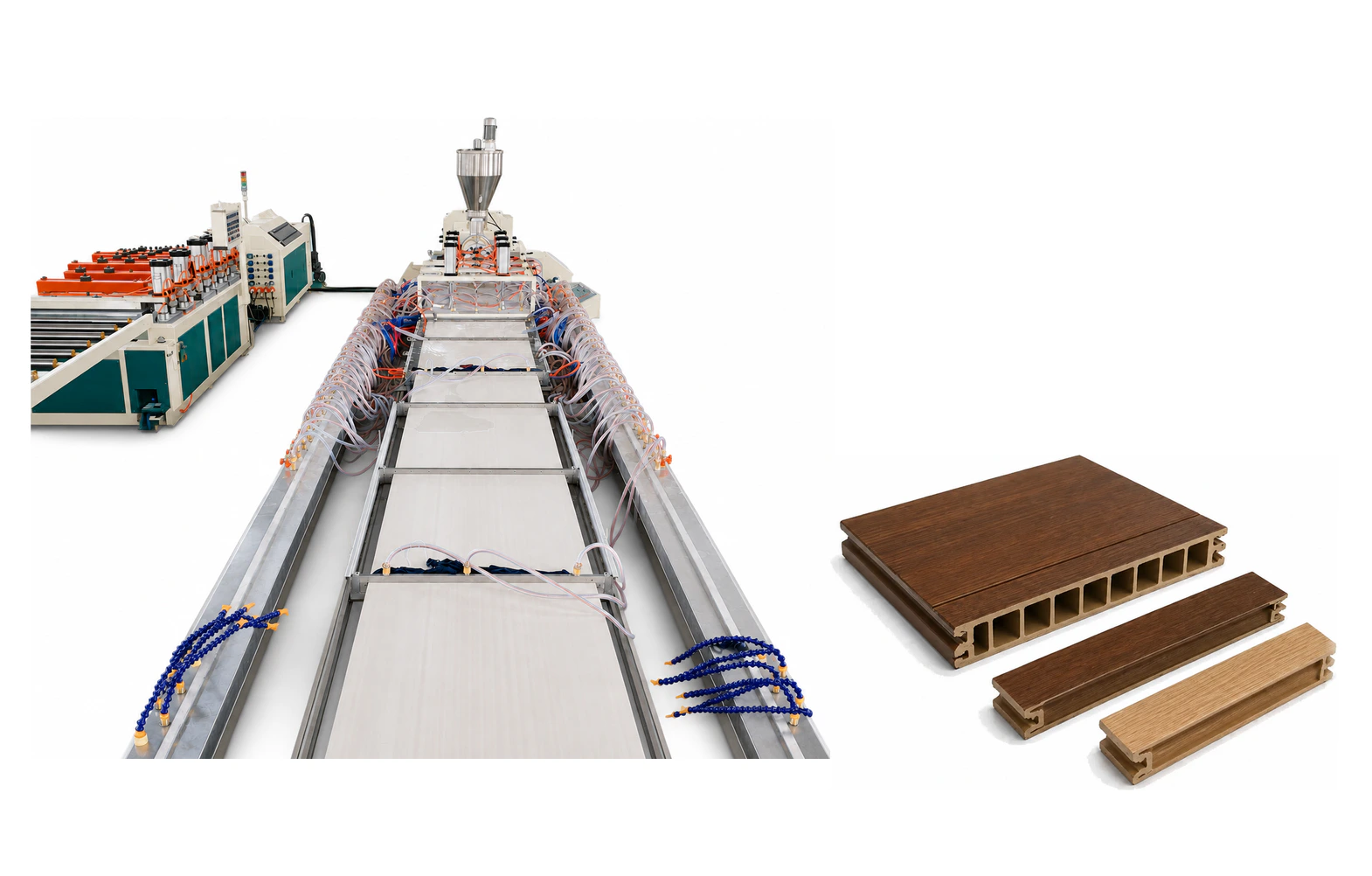
WPC Door Machine
Product Overview
The WPC Door Machine produces hollow-structure wood-plastic composite door panels that combine the natural appearance of wood with the water resistance, termite proof properties, and processability of PVC. These doors have rapidly gained market share in residential and commercial construction as a maintenance-free alternative to wooden doors.
The line features an SJSZ-80/156 or SJSZ-92/188 conical twin-screw extruder, a hollow profile die specifically designed for door panel cross-sections, vacuum calibration and cooling system, and online hot stamping unit for wood grain finishes. It produces door panels 700-1000mm wide and 35-45mm thick with 30-50% wood powder content.
WPC door panels are engineered with internal rib structures that provide rigidity while minimizing material usage. The hollow cross-section reduces weight by 30-40% compared to solid wood doors of the same dimensions, while the PVC matrix provides moisture resistance that prevents warping, swelling, or rotting — common problems with wooden doors in humid environments.
The online hot stamping system applies realistic wood grain patterns directly during extrusion, creating surfaces that closely mimic natural wood. The thermally transferred pattern is embedded in the surface, providing better durability than surface-printed or laminated finishes.
Key Features
Conical twin-screw extruder
Hollow profile die for door panels
Vacuum calibration and cooling
Online hot stamping for wood grain
Synchronized cutting system
Production Process
From raw material to finished product — each step is engineered for quality and efficiency.
Wood Powder Preparation
Wood flour (60-80 mesh) is dried to moisture content below 2%. PVC powder, wood flour, stabilizers, lubricants, and coupling agents are mixed in a high-speed mixer at 120°C.
Extrusion & Plasticizing
The WPC compound enters the conical twin-screw extruder. Processing temperatures (155-175°C) are carefully controlled — high enough to plasticize PVC but below wood degradation temperature (200°C).
Hollow Profile Die Forming
The molten WPC material flows through a hollow profile die that creates the door panel cross-section with internal ribs and chambers for structural rigidity.
Vacuum Calibration & Cooling
The hot profile enters a vacuum calibrator that shapes it to final dimensions. Extended cooling ensures the thick profile solidifies completely without internal stress.
Hot Stamping
Wood grain pattern is transferred from foil to the door surface using heated silicone rollers at 160-180°C. The pattern is thermally embedded in the surface for superior durability.
Cutting & Finishing
A synchronized cutter trims door panels to standard heights (2000mm, 2100mm). Panels are inspected and packaged with protective corner guards.
Technical Specifications
| Extruder Model | SJSZ-80/156 or SJSZ-92/188 |
|---|---|
| Door Panel Width | 700mm - 1000mm |
| Door Thickness | 35mm - 45mm |
| Wood Powder Content | 30-50% |
| Production Speed | 1-3 m/min |
| Total Power | ~120-180 kW |
Why Choose Wings Plastic
Hollow Structure Design
Engineered internal rib structure provides rigidity comparable to solid doors while reducing material usage and weight by 30-40%, lowering both production cost and installation difficulty.
Wood Grain Hot Stamping
Thermal transfer of wood grain patterns creates surfaces that closely mimic natural wood, with the pattern embedded in the surface for superior wear resistance compared to surface printing or lamination.
Moisture & Termite Proof
PVC matrix encapsulates wood particles, preventing moisture absorption and eliminating termite attraction — solving the two biggest failure modes of wooden doors in tropical and humid climates.
Coupling Agent Optimization
Formulation includes coupling agents (maleic anhydride grafted PE/PP) that chemically bond wood fibers to the PVC matrix, improving mechanical properties by 30-50% compared to uncoupled formulations.
No Painting Required
The hot-stamped wood grain finish is complete as extruded — no painting, staining, or surface treatment required, reducing the door total installed cost by 20-30%.
Quality Assurance
Every production line undergoes rigorous quality verification before delivery:
- Panel dimensions (width, thickness, squareness) verified with digital measuring tools
- Surface pattern adhesion tested using cross-hatch tape test
- Screw withdrawal resistance tested at hinge locations to verify structural integrity
- Moisture absorption test (24h water immersion) to verify waterproof properties
Typical Applications
Frequently Asked Questions
WPC doors are waterproof, termite-proof, don't warp or crack, require no painting, and cost 30-50% less than solid wood doors. However, they are heavier than hollow wooden doors and cannot be stained or refinished like natural wood.
30-40% for doors requiring paintability and screw retention. 40-50% for maximum wood appearance and lower cost. Higher wood content improves appearance but reduces moisture resistance and mechanical strength.
Yes, WPC doors can be painted with acrylic or polyurethane paints after light sanding. However, most customers prefer the pre-applied wood grain hot stamping finish, which requires no additional treatment.
Standard widths: 700mm, 800mm, 900mm, 1000mm. Standard heights: 2000mm, 2100mm. Thickness: 35-45mm. Custom sizes are possible with die modifications. The 800x2000x40mm panel is the most popular.
Related Products
Related Technical Articles
Ready to Get Started?
Contact our team for a customized WPC Door Machine solution tailored to your production needs.
Contact Us