
Conical vs Parallel Twin Screw Extruder: Which to Choose?
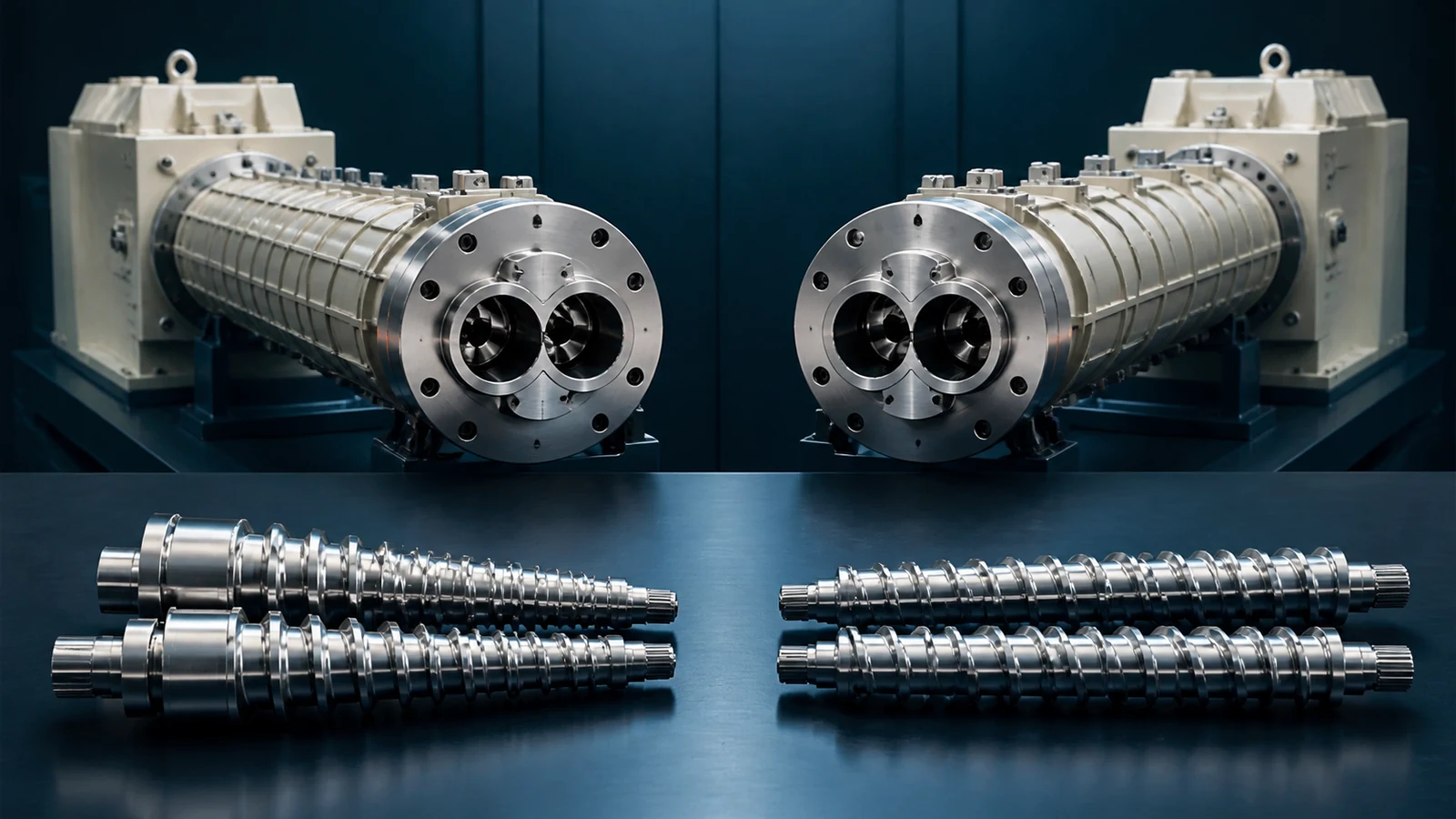
When setting up a PVC profile extrusion line or a WPC production line, one of the most important equipment decisions is choosing between a conical twin-screw extruder and a parallel twin-screw extruder. Both are widely used in PVC processing, but they have distinct advantages and are suited for different applications.
1. Basic Design Differences
Conical Twin-Screw Extruder
In a conical twin-screw extruder, the screw diameter gradually decreases from the feed section to the die end. The feed section has a larger diameter (e.g., 80mm) that tapers to a smaller diameter at the discharge end (e.g., 156mm refers to the screw length-to-diameter ratio, not the exit diameter). This design provides:
- Large feed area for better powder intake
- Natural compression as material moves forward
- Shorter screw length (lower L/D ratio, typically 14:1 to 18:1)
- Lower overall torque requirement
Parallel Twin-Screw Extruder
In a parallel twin-screw extruder, the screw diameter remains constant throughout the barrel. The screws are parallel from feed to die. This design offers:
- Uniform shear along the entire screw length
- Longer processing zone (higher L/D ratio, typically 20:1 to 32:1)
- More flexibility in screw configuration
- Higher torque and output capacity
2. PVC Processing Comparison
| Parameter | Conical Twin-Screw | Parallel Twin-Screw |
|---|---|---|
| L/D Ratio | 14:1 - 18:1 | 20:1 - 32:1 |
| Best for | PVC powder (dry blend) | PVC powder + WPC + filled compounds |
| Output range | 50-500 kg/h | 100-1000+ kg/h |
| Energy efficiency | Excellent (natural compression) | Good (but higher motor power) |
| Screw speed | Low (15-40 rpm) | Medium (20-60 rpm) |
| Cost | Lower | Higher |
| Maintenance | Simpler | More complex |
3. When to Choose Conical Twin-Screw
Conical twin-screw extruders are the workhorse of the PVC profile industry. Choose a conical extruder when:
- You're processing PVC dry blend (powder) directly — no need for pre-pelletizing
- Your products are rigid PVC profiles, ceiling panels, cable trunking, etc.
- You want the best price-to-performance ratio
- Your output requirement is moderate (50-500 kg/h)
- You're processing PVC-based WPC products (PVC + wood powder)
For 80% of rigid PVC profile applications, a conical twin-screw extruder (SJSZ-65/132 or SJSZ-80/156) is the optimal choice. It's cost-effective, reliable, and purpose-built for PVC powder processing.
4. When to Choose Parallel Twin-Screw
Parallel twin-screw extruders excel in more demanding applications. Choose a parallel extruder when:
- You're processing PE/PP-based WPC decking or WPC fencing
- You need high output (500+ kg/h)
- You're processing heavily filled compounds or recycled materials
- You need more venting zones for moisture removal (critical for WPC)
- You want more screw configuration flexibility for different products
5. WPC Processing: A Special Case
For WPC products, the choice depends on the polymer matrix:
- PVC-based WPC (doors, wall panels, foam boards): Use conical twin-screw. PVC processes well at lower temperatures and the conical design handles PVC powder + wood powder blends efficiently.
- PE/PP-based WPC (decking, fencing, cladding): Use parallel twin-screw. PE/PP requires higher processing temperatures, better venting for wood powder moisture, and the longer L/D ratio provides better mixing and degassing.
Not Sure Which Extruder You Need?
Our engineers will help you select the right extruder based on your product, formulation, and output requirements.
Get Expert Advice6. Cost Considerations
Conical twin-screw extruders are generally 20-30% cheaper than parallel twin-screw extruders of similar output capacity. They also consume less energy per kilogram of output due to the natural compression effect of the conical design.
However, parallel twin-screw extruders offer longer barrel life and can handle a wider range of materials, which may justify the higher initial investment if you plan to produce diverse products.
Summary
For most PVC extrusion applications — profiles, sheets, boards, and PVC-based WPC — the conical twin-screw extruder is the recommended choice. It's purpose-built for PVC powder processing, cost-effective, and proven reliable across thousands of installations.
For PE/PP-based WPC products or high-output applications requiring extensive venting and mixing, the parallel twin-screw extruder is the better option despite its higher cost.
Still have questions? Check out our related articles on PVC formulation and temperature control, or contact our team for personalized recommendations.