
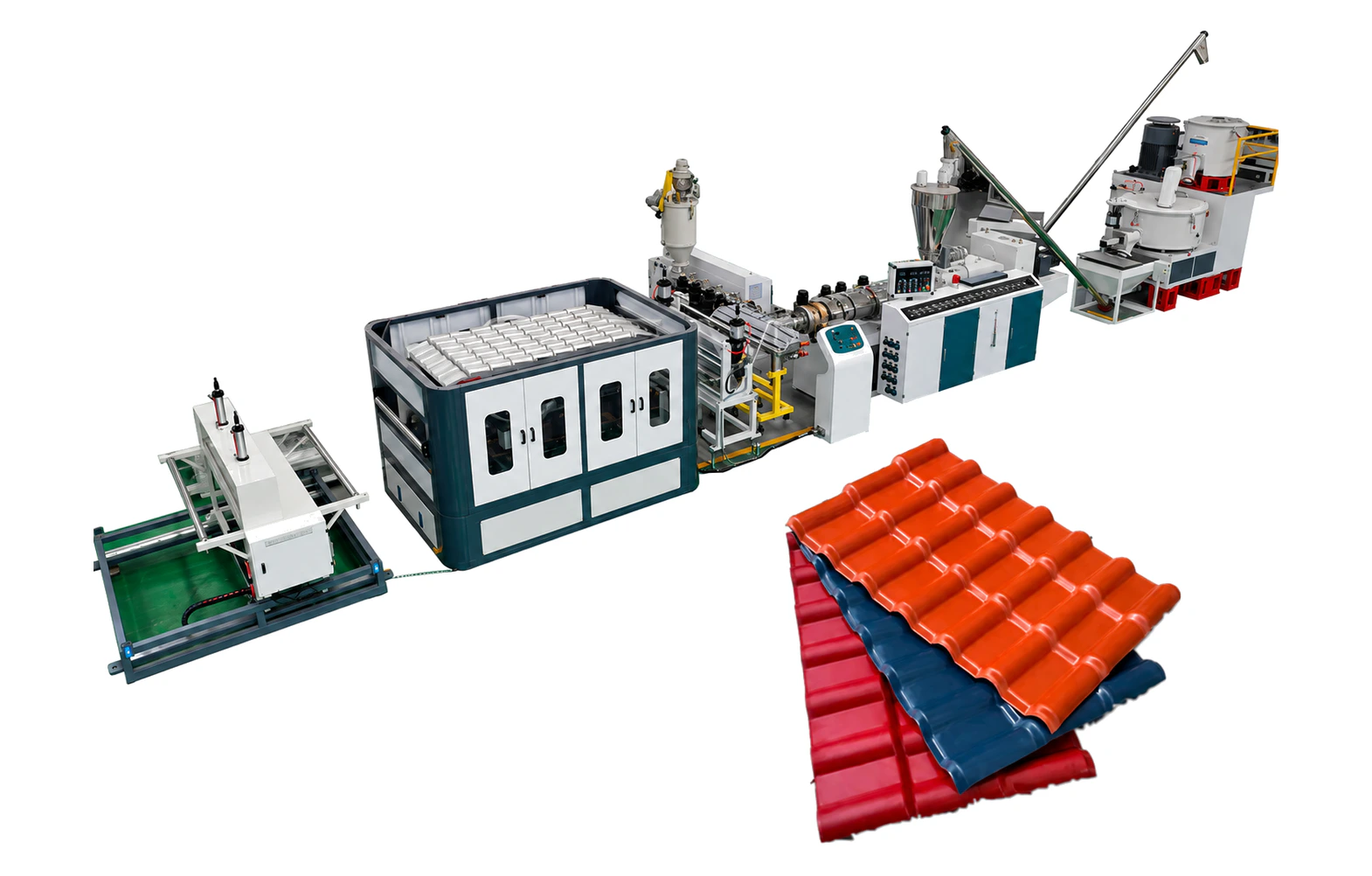
PVC Roof Tile Machine
Product Overview
The PVC Roof Tile Extrusion Line produces multi-layer synthetic roof tiles that combine a PVC base with an ASA (Acrylonitrile Styrene Acrylate) or PMMA surface layer for superior UV resistance and weatherability. These tiles replicate the appearance of traditional clay or concrete tiles while offering significant weight savings and easier installation.
The co-extrusion system uses two extruders: a main extruder (SJ-90) for the PVC base layer and a smaller co-extruder (SJ-45) for the ASA/PMMA cap layer. The multi-layer T-die or annular die combines both materials into a single sheet with excellent interlayer adhesion, then the corrugated forming station creates the tile profile.
ASA and PMMA cap layers provide exceptional UV resistance — ASA tiles maintain color and impact resistance for 15-25 years, significantly outperforming unpainted PVC tiles. The cap layer also provides a high-gloss, self-cleaning surface that resists dirt accumulation and biological growth.
The line produces tiles in widths of 880mm and 1040mm with thicknesses of 2-3mm, compatible with standard roof batten spacing. Two or three-layer configurations (ASA/PVC/ASA) are available for applications requiring UV protection on both sides, such as transparent or translucent roof sections.
Key Features
Co-extrusion system (PVC base + ASA/PMMA cap)
Multi-layer T-die or annular die
Tile forming and cooling station
Online cutting and stacking
UV resistance surface layer
Production Process
From raw material to finished product — each step is engineered for quality and efficiency.
Dual Material Preparation
PVC base compound (with filler, stabilizers, pigments) and ASA/PMMA cap compound are prepared separately. The cap compound uses high-grade ASA resin for UV resistance.
Co-Extrusion
Two extruders feed a multi-layer die: the main extruder provides the PVC base (80-90% of thickness), the co-extruder applies the ASA/PMMA cap (10-20% of thickness).
Sheet Forming
The multi-layer sheet exits the die as a flat or tubular form. The layers are bonded by the melt contact — no adhesive is needed. Interlayer adhesion is molecular.
Tile Profile Forming
The sheet passes through a corrugated forming machine that creates the tile wave profile. Forming temperature is controlled to prevent stress or cracking.
Cooling & Sizing
The formed tile passes through cooling and sizing stations that fix the profile dimensions and prevent post-extrusion deformation.
Cutting & Stacking
A synchronized cutter trims tiles to standard lengths. Tiles are stacked with protective separators and packaged for shipment.
Technical Specifications
| Extruder Model | SJ-90 + SJ-45 (co-extrusion) |
|---|---|
| Tile Width | 880mm / 1040mm |
| Tile Thickness | 2mm - 3mm |
| Layers | 2-3 layers (ASA/PVC/ASA) |
| Production Speed | 3-6 m/min |
| Total Power | ~100-150 kW |
Why Choose Wings Plastic
ASA/PMMA Co-Extrusion
The ASA or PMMA cap layer provides 15-25 year UV resistance — far exceeding plain PVC tiles (5-7 years). This premium feature commands significantly higher market pricing.
Molecular Interlayer Bond
Co-extrusion creates molecular-level adhesion between PVC and ASA layers — no delamination possible, unlike glued or laminated alternatives.
Dual-Sided Option
Three-layer (ASA/PVC/ASA) configuration provides UV protection on both sides for translucent tiles or applications requiring both interior and exterior weatherability.
Lightweight Advantage
At 2-3mm thickness and 2.5-3.5 kg/m², PVC-ASA roof tiles are 70% lighter than concrete tiles, reducing roof structural requirements and installation labor.
Self-Cleaning Surface
The high-gloss ASA surface resists dirt accumulation and biological growth (algae, moss), maintaining appearance with minimal maintenance over the product lifetime.
Quality Assurance
Every production line undergoes rigorous quality verification before delivery:
- Cap layer thickness measured using cross-section microscopy
- Interlayer adhesion tested per ASTM D903 (peel test)
- UV accelerated weathering (QUV) for 2000 hours to verify color retention
- Impact resistance tested at low temperature (-10°C) per ASTM D5420
Typical Applications
Frequently Asked Questions
ASA-capped tiles maintain color and mechanical properties for 15-25 years in normal climates. PMMA-capped tiles offer similar UV resistance with slightly better transparency for translucent applications.
Co-extrusion creates molecular bonding between layers during the melt phase — no adhesive, no delamination risk. Laminated tiles can delaminate under thermal cycling, while co-extruded tiles cannot.
Yes, PVC-ASA tiles are compatible with standard roof batten spacing and can be installed over existing roofing (overlay) or on new roof structures. Installation is similar to traditional tiles but faster due to larger tile size.
Standard colors include brick red, terracotta, grey, blue, and green. Custom colors are available with minimum order quantities. The ASA cap layer helps improve outdoor color stability.
Related Products
Related Technical Articles
Ready to Get Started?
Contact our team for a customized PVC Roof Tile Machine solution tailored to your production needs.
Contact Us