
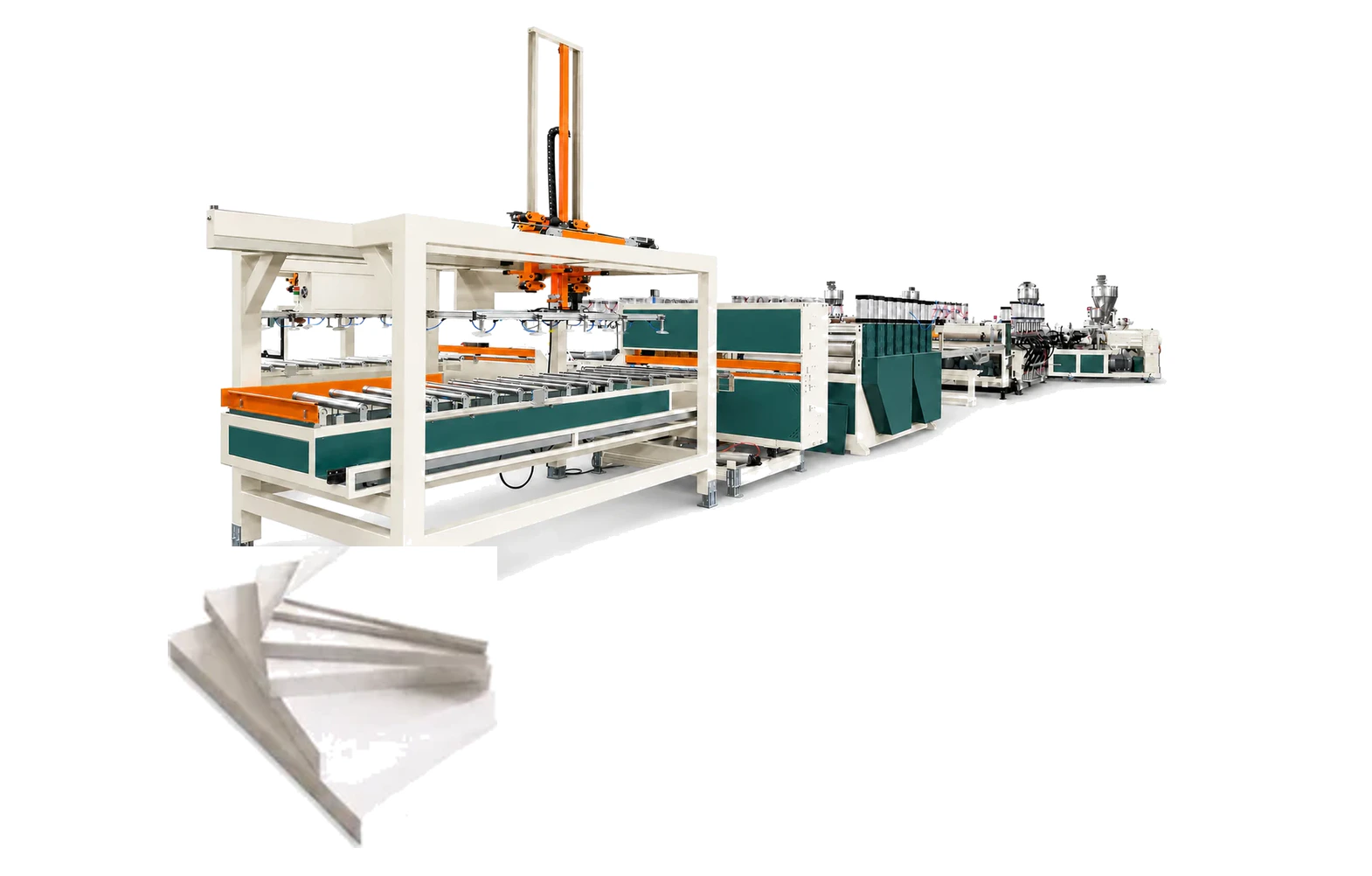
PVC Celuka Foam Board Machine
Product Overview
The PVC Celuka Foam Board Extrusion Line is an advanced production system for manufacturing rigid PVC foam boards with a hard, smooth skin and a foamed core. This unique structure — known as the Celuka process — produces boards with an excellent strength-to-weight ratio, superior surface finish, and wood-like workability.
Our line produces boards from 1220mm to 2050mm wide with thicknesses ranging from 3mm to 25mm and densities of 0.5-0.7 g/cm³. The SJSZ-80/156 or SJSZ-92/188 conical twin-screw extruder provides the high output capacity (250-400 kg/h) needed for large-format board production, while the Celuka die with skin-forming technology creates the characteristic hard surface.
The Celuka process differs from free foam in that the molten PVC passes through a specially designed die that compresses the outer surface as it exits, creating a dense skin (0.3-0.5mm thick) while the core foams freely. This skin provides scratch resistance, paintability, and printability — making Celuka boards the preferred choice for advertising, furniture, and construction applications.
PVC foam boards are one of the fastest-growing PVC product categories, driven by demand for lightweight, water-resistant, and printable substrates in advertising, furniture, and construction. Our production line includes formulation guidance for achieving target density, cell structure, and surface quality across different board thicknesses.
Key Features
Conical twin-screw extruder
Celuka die with skin-forming technology
Multi-roll calibrator for thickness control
Online cooling and edge trimming
Automatic stacking system
Production Process
From raw material to finished product — each step is engineered for quality and efficiency.
Foam Formulation
PVC compound with foaming agent (ADC NaHCO3), stabilizer, and process aids is mixed. Precise foaming agent dosing controls final board density (0.5-0.7 g/cm³).
Extrusion & Plasticizing
The compound is processed at carefully controlled temperatures (160-180°C) — high enough for gelation but below the foaming agent decomposition temperature.
Celuka Die Forming
The molten PVC passes through the Celuka die, which has a sizing mandrel that compresses the outer surface into a hard skin while the interior begins foaming.
Calibration & Foaming
The board enters a vacuum calibrator that controls the final dimensions while the core completes its foaming process. Precise temperature management controls cell size.
Cooling & Edge Trimming
Multi-zone cooling rolls stabilize the board. Edge trimmers remove the edge beads (foam overflow) to achieve clean, straight board edges.
Cutting & Stacking
A synchronized cutting saw cuts boards to standard sizes (1220x2440mm, 1560x3050mm, 2050x3050mm). An automatic stacker collects finished boards.
Technical Specifications
| Extruder Model | SJSZ-80/156 or SJSZ-92/188 |
|---|---|
| Board Width | 1220mm - 2050mm |
| Board Thickness | 3mm - 25mm |
| Density | 0.5-0.7 g/cm³ |
| Production Speed | 1-3 m/min |
| Total Power | ~150-220 kW |
Why Choose Wings Plastic
Celuka Skin Technology
The Celuka die creates a hard, smooth skin (0.3-0.5mm) that is scratch-resistant, paintable, and printable — superior to free foam boards which have a softer, more porous surface.
Density Control System
Precise foaming agent dosing and temperature management allow density adjustment from 0.5 to 0.7 g/cm³, optimizing the strength-to-weight ratio for different applications.
Wide Format Capability
Produces boards up to 2050mm wide — the largest standard format in the market — enabling production of full-size advertising panels and furniture components.
Uniform Cell Structure
Optimized cooling profile and vacuum calibration produce fine, uniform foam cells throughout the board cross-section, ensuring consistent mechanical properties.
Formulation Support
We provide proven Celuka formulations for different density targets, board thicknesses, and application requirements — including fire-retardant grades for construction.
Quality Assurance
Every production line undergoes rigorous quality verification before delivery:
- Board density verified by weight/volume measurement per batch
- Skin thickness measured at multiple points using cross-section microscopy
- Surface flatness checked with straightedge across full board width
- Cell structure inspected under microscope for uniformity and absence of large voids
Typical Applications
Frequently Asked Questions
Celuka boards have a hard, dense skin (0.3-0.5mm) created by the die compression, making them more scratch-resistant and printable. Free foam boards have a softer, more uniform surface throughout. Celuka is preferred for furniture and advertising; free foam is used for thermal insulation.
Standard sizes: 1220x2440mm, 1560x3050mm, 2050x3050mm. Thicknesses: 3-25mm. Custom sizes can be cut from larger boards. The maximum width is determined by the die width.
The Celuka process typically produces boards with density 0.5-0.7 g/cm³. Lower density (0.45) is possible with formulation adjustments but may reduce surface hardness. Higher density (0.75+) provides greater strength.
Yes, the hard Celuka skin provides an excellent surface for UV printing, screen printing, and painting. No primer is required for most printing applications. The surface can also be laminated with decorative films.
Related Products
Related Technical Articles
Ready to Get Started?
Contact our team for a customized PVC Celuka Foam Board Machine solution tailored to your production needs.
Contact Us