
PVC Foaming Process: Celuka vs Free Foam
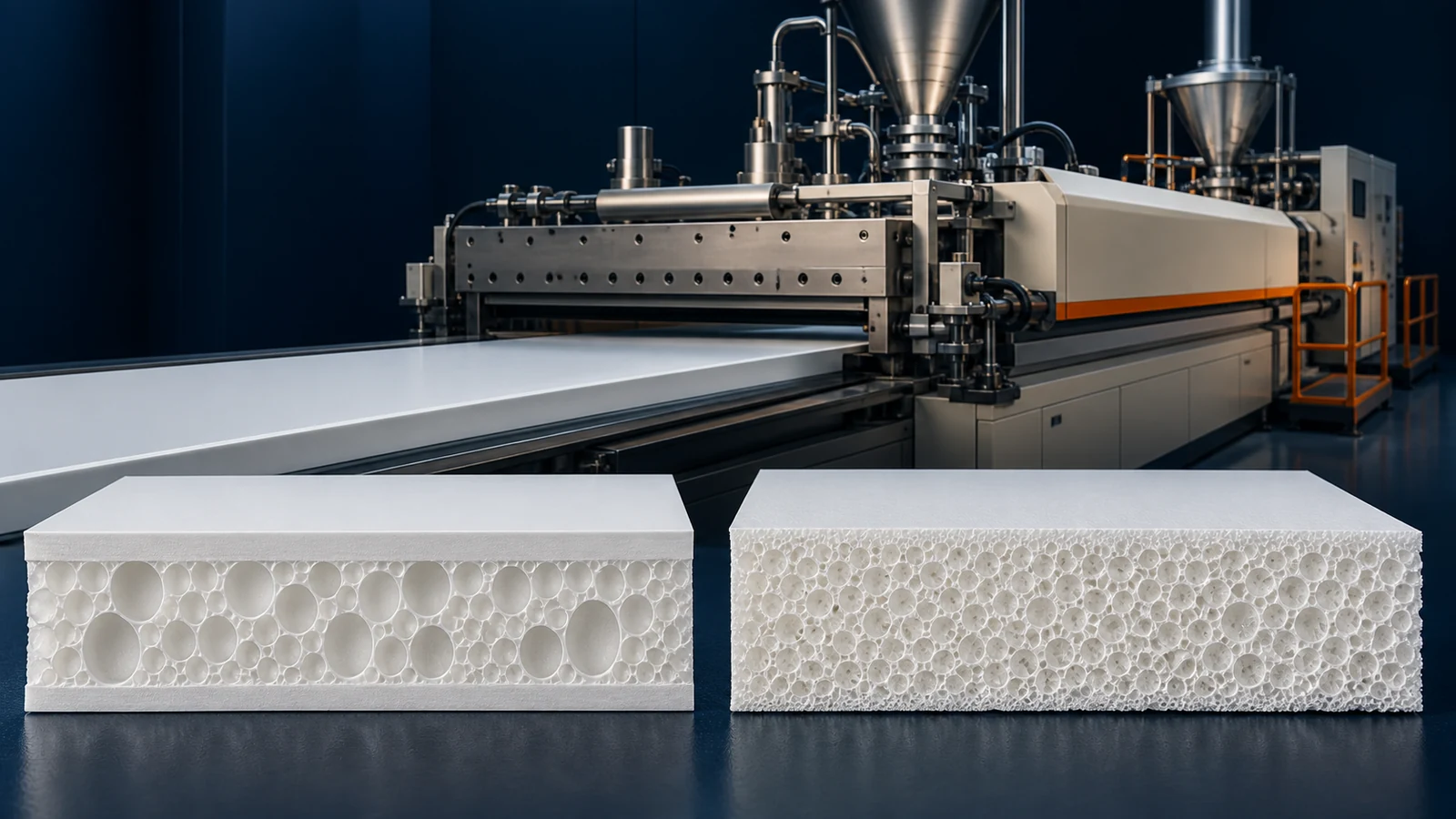
PVC foam board (also known as Celuka board or Andy board) is one of the most versatile products in the plastics industry. It combines the durability of rigid PVC with a foamed core that reduces weight, improves insulation, and lowers material costs. Two primary foaming processes dominate the market: Celuka (skin) foaming and free foaming. Understanding the differences between these processes is essential for selecting the right foam board extrusion line for your application.
This article provides a detailed technical comparison of both processes, covering die design, density control, surface quality, and typical applications.
1. Overview of PVC Foam Board Extrusion
PVC foam board extrusion involves adding a chemical blowing agent (typically sodium bicarbonate or azodicarbonamide) to the PVC formulation. As the melt exits the die, the pressure drop causes the blowing agent to decompose and release gas, creating a cellular structure within the board.
The key difference between Celuka and free foam lies in how the foam surface is controlled:
- Celuka process: A special die with a calibrated sleeve forces the foam to form a dense, hard skin on the surface while the core remains foamed.
- Free foam process: The melt is allowed to expand freely without surface constraint, producing a more uniform but softer surface.
2. Celuka Foaming Process
Named after the original Celuka technology developed by Ugine Kuhlmann (now part of Atochem), the Celuka process is the most widely used method for producing rigid PVC foam boards.
How It Works
The Celuka die features a unique design with an internal mandrel and an external cooling sleeve (calibrator). As the PVC melt exits the die:
- The melt passes through a die that shapes the outer dimensions of the board.
- Immediately after the die, the board enters a vacuum calibrator with cooled walls.
- The vacuum and cooling cause the outer layer of the melt to solidify rapidly, forming a hard, dense skin (0.3-0.8 mm thick).
- The inner core continues to expand due to the blowing agent, creating a foamed center.
Key Characteristics
- Density: 0.50-0.70 g/cm³ (compared to 1.40 g/cm³ for solid PVC)
- Surface: Hard, smooth, glossy surface that can be painted or printed
- Surface hardness: Shore D 70-80 (similar to rigid PVC)
- Core structure: Closed-cell foam with uniform cell distribution
- Screw type: Typically conical twin-screw extruder (e.g., SJSZ80/156)
The Celuka process produces boards with a surface quality that rivals solid PVC, making it ideal for visible applications like furniture, signage, and decorative panels.
Advantages of Celuka
- Excellent surface hardness and scratch resistance
- Superior screw-holding capacity (dense skin provides grip)
- Better printability and paint adhesion
- Higher bending strength due to the dense skin
- Can be processed like wood — sawed, nailed, screwed, and glued
Limitations
- More complex die and calibrator design
- Higher equipment cost
- Limited to specific thickness ranges (typically 3-25 mm)
- Requires precise temperature control across multiple zones
3. Free Foam Process
In the free foam process, the PVC melt containing the blowing agent exits a flat die (T-die) and expands freely without any external constraint on the surface. The board then passes through a three-roll calendar to control thickness and surface finish.
How It Works
- The PVC melt with blowing agent exits through a T-die (similar to sheet extrusion).
- The melt expands freely in all directions as pressure drops.
- A three-roll calendar system controls the final thickness and provides a smooth surface.
- The resulting board has a more uniform density distribution throughout.
Key Characteristics
- Density: 0.55-0.75 g/cm³
- Surface: Fine, slightly textured (matte) finish — no hard skin
- Surface hardness: Shore D 50-60 (softer than Celuka)
- Core structure: More uniform cell structure throughout
- Screw type: Conical twin-screw or counter-rotating parallel twin-screw
Advantages of Free Foam
- Simpler die design (standard T-die)
- Lower equipment cost
- Can produce thinner boards (1-5 mm)
- More uniform density profile
- Excellent for applications where surface hardness is not critical
Limitations
- Softer surface — less scratch and impact resistant
- Matte finish requires additional processing for glossy appearance
- Lower screw-holding strength
- Not suitable for furniture or visible decorative applications
4. Technical Comparison Summary
| Parameter | Celuka Foam | Free Foam |
|---|---|---|
| Density (g/cm³) | 0.50-0.70 | 0.55-0.75 |
| Surface hardness | Shore D 70-80 | Shore D 50-60 |
| Surface finish | Smooth, glossy | Matte, slightly textured |
| Skin thickness | 0.3-0.8 mm | No distinct skin |
| Thickness range | 3-25 mm | 1-10 mm |
| Die type | Special Celuka die + calibrator | Standard T-die |
| Bending strength | High (dense skin) | Moderate |
| Screw holding | Excellent | Good |
| Equipment cost | Higher | Lower |
| Typical output | 200-500 kg/h | 150-350 kg/h |
5. Application Guide: Which Process to Choose?
Choose Celuka For:
- Furniture and cabinetry: Kitchen cabinets, bathroom vanities, wardrobe panels
- Signage and advertising: Display boards, exhibition stands, digital printing substrates
- Construction: Wall cladding, ceiling panels, partition walls
- Vehicle interiors: Train and bus interior panels
- Any application requiring: Paintability, print adhesion, screw fastening, or wood-like processing
Choose Free Foam For:
- Industrial applications: Ducting, chemical tank linings, insulation boards
- Backing materials: Underlayment, core layers in composite panels
- Thin boards (1-5 mm): Where Celuka is not practical
- Cost-sensitive applications: Where surface hardness is not required
Planning a Foam Board Production Line?
Our Celuka foam board machines support both skin and free foam processes. Get a customized production line recommendation.
Get a Quote6. Key Formulation Considerations
Regardless of the process, the foam formulation requires careful attention to these components:
Blowing Agent
Sodium bicarbonate (NaHCO3) is the most common blowing agent for PVC foam. It decomposes at 150-200°C, releasing CO2. Typical dosage: 0.5-1.5 phr. For finer cell structure, azodicarbonamide (ADC) can be used at 0.3-0.8 phr, but it requires higher decomposition temperatures.
Stabilizer Selection
The stabilizer must provide sufficient thermal stability for the foaming temperature range. Ca-Zn stabilizers (3-5 phr) are the preferred choice for foam boards. The stabilizer also acts as a blowing agent activator in some systems.
Lubricant Balance
Foam formulations require more external lubrication than solid PVC to prevent sticking in the die and calibrator. However, excessive lubrication can cause poor cell structure and surface defects.
Filler Loading
Calcium carbonate loading is typically lower in foam formulations (5-15 phr) to avoid interfering with cell formation. Excessive filler can collapse the foam structure.
7. Process Troubleshooting
| Problem | Likely Cause | Solution |
|---|---|---|
| Rough surface | Insufficient skin formation | Increase calibrator cooling, check vacuum |
| Low foam density | Too much blowing agent | Reduce blowing agent to 0.8-1.0 phr |
| High density (heavy board) | Blowing agent decomposing too early | Lower barrel temps, check stabilizer |
| Surface blisters | Moisture in raw materials | Dry CaCO3, check resin moisture |
| Uneven cell structure | Poor dispersion or wrong lubricant | Check mixer efficiency, adjust lubricant balance |
| Board warping | Uneven cooling | Check calibrator water flow, align die |
Related Products
This guide applies to our PVC sheet and board extrusion lines, including:
Conclusion
Both Celuka and free foam processes have their place in PVC foam board production. For most commercial applications — especially furniture, signage, and decorative panels — the Celuka process is the preferred choice due to its superior surface quality and mechanical properties. Free foam remains valuable for thin boards, industrial applications, and cost-sensitive projects.
For more technical insights, explore our articles on PVC formulation and twin-screw extruder selection.