
PVC Formulation Guide for Profile Extrusion
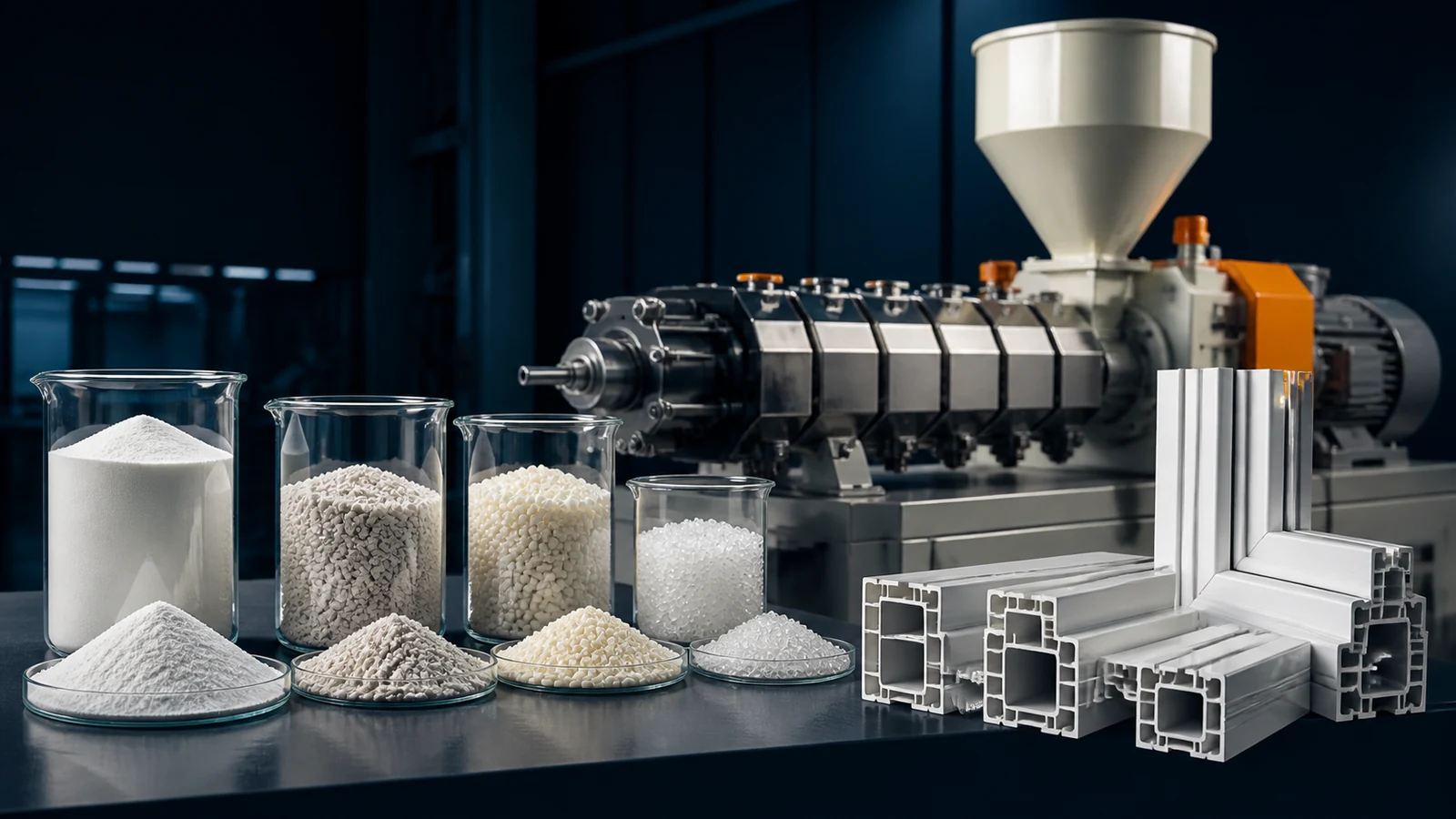
Creating the right PVC formulation is the single most important factor in producing high-quality rigid profiles. Whether you're manufacturing PVC wall panels, window profiles, or ceiling panels, the formulation determines surface finish, mechanical strength, dimensional stability, and production efficiency.
This guide covers every component of a rigid PVC profile formulation — from resin selection to processing aids — with practical recommendations grounded in real extrusion projects.
1. PVC Resin Selection: K-Value Matters
The PVC resin is the foundation of your formulation. The most critical parameter is the K-value (or Fikentscher K-value), which indicates the molecular weight of the resin:
- K-Value 57-60 (low molecular weight): Easiest to process, good for thin-walled profiles and high-speed extrusion. Lower mechanical strength.
- K-Value 66-68 (medium molecular weight): The sweet spot for most rigid PVC profiles. Good balance of processability and mechanical properties. Most commonly used for window profiles, wall panels, and ceiling panels.
- K-Value 70-72 (high molecular weight): Superior mechanical strength and impact resistance. Harder to process, requires higher temperatures and torque. Used for pressure pipes and high-strength applications.
For most rigid PVC profile extrusion, we recommend SG-5 type resin (K-value 66-68). It provides the best balance of processability and final product quality.
phr means parts by mass per 100 parts by mass of resin, not a quantity per hour.
2. Stabilizer Systems
Thermal stabilizers prevent PVC degradation during processing. The three main systems used today are:
Calcium-Zinc (Ca-Zn) Stabilizers
The most environmentally friendly option, Ca-Zn stabilizers are increasingly preferred for export markets (especially EU and North America). They provide adequate thermal stability for most profile applications and comply with REACH and RoHS regulations.
Typical dosage: 3-5 phr (parts per hundred resin)
Organotin Stabilizers
Offering excellent thermal stability and transparency, organotin stabilizers are ideal for transparent applications and high-temperature processing. However, they are more expensive and face regulatory restrictions in some markets.
Typical dosage: 1-2 phr
Lead-Based Stabilizers
Still used in some markets due to low cost and excellent long-term stability, but being phased out globally due to toxicity concerns. We recommend transitioning to Ca-Zn systems for all new formulations.
3. Lubricant System: Internal vs External
Lubricants are perhaps the most misunderstood component of PVC formulations. They fall into two categories:
- Internal lubricants (e.g., fatty alcohols, ester waxes) reduce melt viscosity and improve flow. They are compatible with PVC and work inside the melt.
- External lubricants (e.g., paraffin wax, PE wax) reduce friction between the PVC melt and metal surfaces (barrel, die). They have low compatibility with PVC and migrate to the surface.
The balance between internal and external lubrication is critical:
- Too much external lubricant → plate-out on die surfaces, poor surface finish, slow gelation
- Too little external lubricant → high motor load, sticking to metal surfaces, degradation
- Too much internal lubricant → reduced Vicat temperature, lower mechanical strength
Typical formulation: 0.5-1.5 phr internal + 0.3-0.8 phr external lubricant
4. Fillers: Calcium Carbonate (CaCO3)
Calcium carbonate is the most commonly used filler in PVC profiles, serving multiple purposes:
- Cost reduction (CaCO3 is significantly cheaper than PVC resin)
- Improved dimensional stability and rigidity
- Better surface finish and printability
- Reduced shrinkage
Key considerations when selecting CaCO3:
- Particle size: 400-800 mesh (15-35 μm) for standard profiles; 1250 mesh (10 μm) for high-gloss surfaces
- Coating: Stearic acid-coated (active) CaCO3 disperses better and has less moisture
- Loading level: 10-30 phr for structural profiles; 30-50 phr for decorative profiles
Loading CaCO3 beyond 50 phr significantly reduces impact strength and makes the profile brittle. For high-quality profiles, keep it under 30 phr.
5. Processing Aids and Impact Modifiers
ACR (Acrylic Processing Aid)
ACR processing aids promote PVC fusion/gelation, improve melt strength and extensibility, and ensure smooth extrusion. They are essential for high-speed profile extrusion.
Typical dosage: 1-3 phr
CPE (Chlorinated Polyethylene)
CPE is the primary impact modifier for rigid PVC profiles, especially for outdoor applications like window profiles. It dramatically improves low-temperature impact resistance.
Typical dosage: 8-12 phr for window profiles; 4-6 phr for indoor profiles
6. Titanium Dioxide (TiO2)
TiO2 serves as both a white pigment and a UV stabilizer. For outdoor profiles, it provides essential UV protection:
- Indoor profiles: 2-4 phr (mainly for whiteness)
- Outdoor profiles: 4-8 phr (for UV protection and whiteness)
Use rutile-grade TiO2 for best weatherability. Anatase-grade is cheaper but yellows faster outdoors.
Sample Formulation: PVC Wall Panel
Here's a reference formulation for a standard PVC wall panel (indoor application):
| Component | Dosage (phr) | Function |
|---|---|---|
| PVC Resin (SG-5, K-67) | 100 | Base polymer |
| Ca-Zn Stabilizer | 3.5 | Thermal stability |
| ACR Processing Aid | 2.0 | Fusion promotion |
| CPE Impact Modifier | 6.0 | Impact resistance |
| Internal Lubricant (OPE) | 0.8 | Melt flow |
| External Lubricant (PE Wax) | 0.5 | Release & flow |
| CaCO3 (800 mesh, coated) | 25 | Filler / cost reduction |
| TiO2 (Rutile) | 3.0 | White pigment |
| Stearic Acid | 0.3 | Dispersing aid |
Need Help with Your PVC Formulation?
Our engineering team can help you optimize formulations for your specific product and market requirements.
Contact Our EngineersRelated Products
This formulation guide applies to the following PVC profile extrusion machines:
- PVC Wall Panel Extrusion Line
- PVC Ceiling Panel Machine
- PVC Window Profile Extrusion Line
- PVC Door Frame Machine
Conclusion
A well-balanced PVC formulation is the key to producing high-quality rigid profiles efficiently. Start with a proven formulation like the one above, then adjust based on your specific requirements, raw material availability, and market conditions. Remember that formulation optimization is an iterative process — small changes can have significant effects on processing behavior and final product quality.
For more technical insights, check out our related articles on extruder selection and die design.