
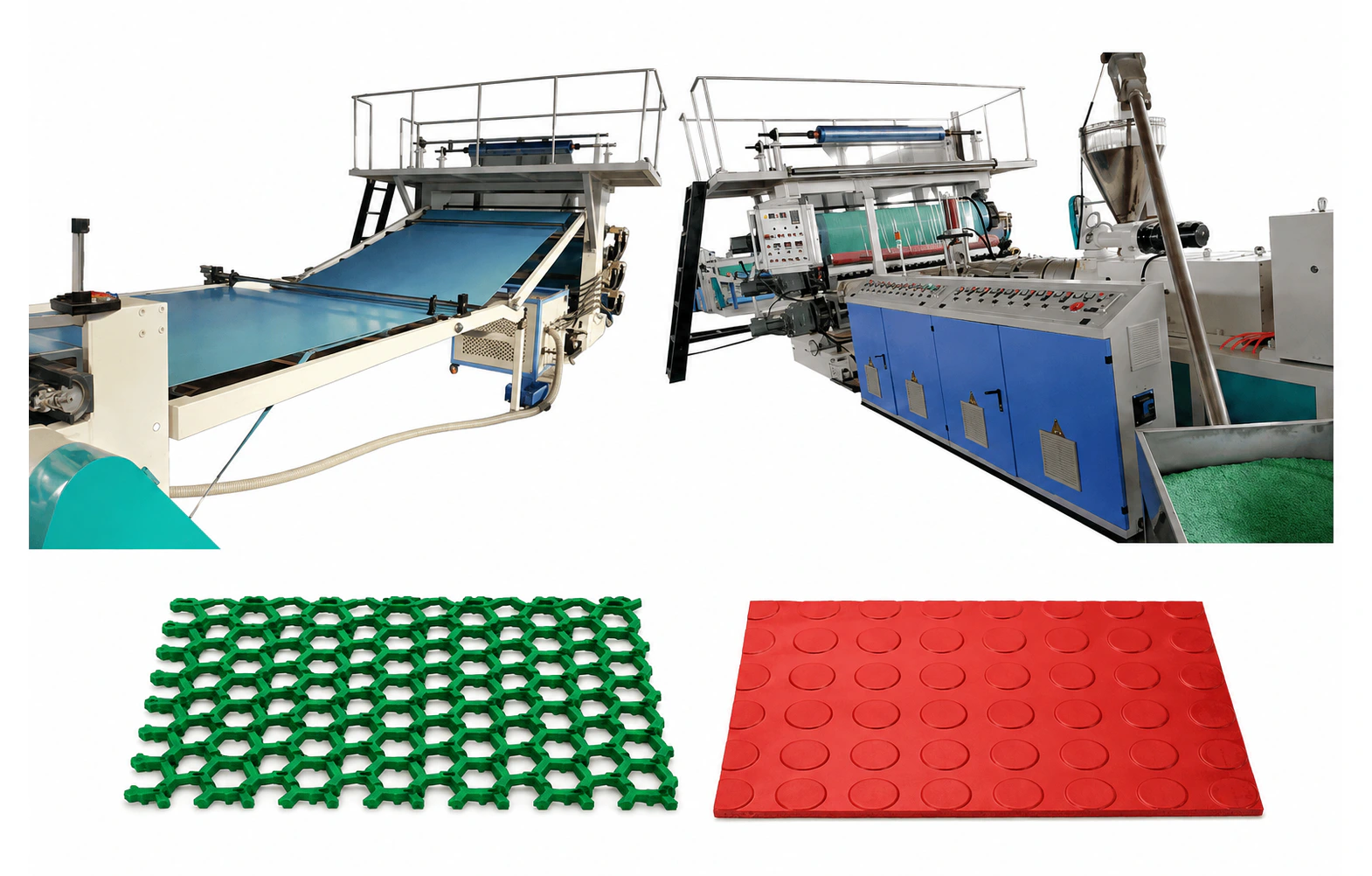
PVC Calender Anti-Slip Chain & Coin Mat Extrusion Machine
Product Overview
The PVC Calender Anti-Slip Chain & Coin Mat Extrusion Machine is dedicated to flexible calendered PVC floor-mat rolls. It produces solid embossed surfaces such as coin, diamond, dot, strip, or pane patterns and open chain or hollow-grid structures. It is not the coil-loop car-mat line; the two product families use different forming and downstream equipment.
A complete calender route combines automatic feeding, conical twin-screw extrusion, melt filtration, a flat die, multi-roll calender forming, cooling, edge trimming, haul-off, and winding. Open chain mats add an online hollow-slitting section. Solid embossed mats can add carpet, non-woven, or film lamination according to the backing specification.
Published configurations use SJZ-65/132, SJZ-80/156, or SJZ-92/188 extruders. Their nominal output bands cover 180–250 kg/h, 300–400 kg/h, and 600–800 kg/h respectively, with finished working widths from 1200 to 2000 mm. Final capacity depends on compound formulation, width, thickness, pattern depth, and cooling demand.
Key Features
Dedicated calender route for solid embossed and open chain PVC mats
Flat-die and multi-roll forming for stable width and surface definition
Optional online hollow slitting for open-grid chain structures
Optional carpet, non-woven, or film backing lamination
Controlled cooling, edge trimming, haul-off, and tension winding
Production Process
The process route is configured around the finished mat structure, backing, width, and output target.
Compound Preparation
PVC resin, plasticizer, stabilizer, filler, pigment, and performance additives are mixed for the specified flexibility, color, and anti-slip target.
Feeding & Twin-Screw Extrusion
The prepared compound is metered into the selected conical twin-screw extruder and plasticized under controlled temperature and torque.
Filtration & Flat-Die Distribution
The homogeneous melt passes through filtration and a wide flat die to establish stable flow across the full working width.
Calender Forming & Embossing
Multi-roll calendering controls sheet thickness and reproduces the selected coin, diamond, dot, strip, pane, or chain pattern.
Cooling, Slitting & Lamination
Cooling fixes the structure; chain mats can be hollow-slit, while solid mats can receive an optional backing or film layer.
Trimming, Haul-Off & Winding
Edges are trimmed and the finished mat is pulled and wound under controlled tension for printing, cutting, or packing.
Technical Specifications
| Finished Products | Solid embossed coin/diamond/dot mats; open chain or hollow-grid mats |
|---|---|
| Main Extruder | SJZ-65/132, SJZ-80/156, or SJZ-92/188 |
| Nominal Output | 180–250 / 300–400 / 600–800 kg/h by configuration |
| Finished Width | 1200–2000 mm |
| Main Motor Range | Approximately 37–110 kW by extruder size |
| Optional Modules | Hollow slitting, lamination, printing, embossing, and winding configuration |
Configuration Guidance
Choose by Output
Select the extruder and calender width from the target kg/h, mat thickness, formulation, and annual operating hours.
Define the Surface
Confirm whether the product is a solid embossed mat or an open chain structure because the downstream forming and slitting route differs.
Specify the Backing
Carpet, non-woven, film, or unbacked construction changes the required lamination, heating, and winding sections.
Plan Downstream Finishing
Share roll diameter, edge format, printing, cutting, and packing requirements so the line exits in the correct saleable format.
Quality Checks
- Check finished width and thickness across the full web at stable production speed.
- Inspect embossing depth, chain opening, and anti-slip texture consistency.
- Verify edge-trim accuracy, hollow-slitting alignment, and backing bond where specified.
- Confirm winding tension, roll diameter, and telescoping control before acceptance.
Typical Applications
Frequently Asked Questions
No. Coil-loop mats require dedicated loop extrusion, heating, forming, and backing equipment. Use the separate PVC Coil Loop Car & Door Mat Extrusion Machine page for that configuration.
Selection depends on the required output and working width. Published ranges progress from SJZ-65/132 at 180–250 kg/h to SJZ-92/188 at 600–800 kg/h.
Yes, within the calender-mat family. The open structure requires the matching pattern/forming arrangement and online hollow-slitting configuration.
Yes. Carpet, non-woven, or film lamination can be configured for solid products when the bonding method and final roll specification are confirmed.
Related Products
Related Technical Articles
Plan Your Calender Mat Line
Send the target mat pattern, working width, thickness, output, backing, roll diameter, and local voltage. We will configure the correct calender, cooling, finishing, and winding sections.
Contact Us