
PVC Stabilizer Selection: Ca-Zn vs Organotin — Complete Comparison
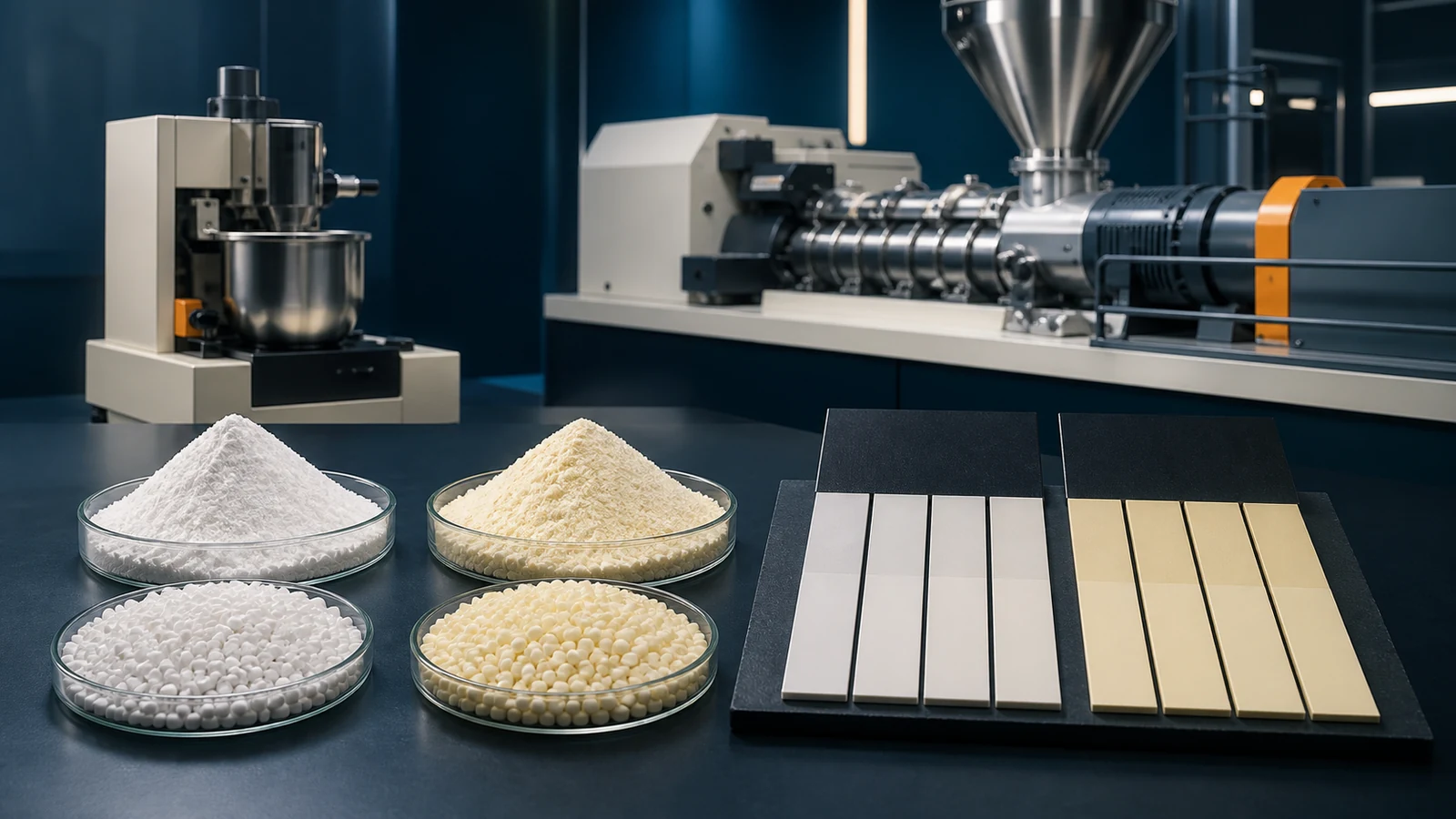
Choosing the right thermal stabilizer is one of the most consequential decisions in PVC extrusion formulation. It determines your processing window, your product's regulatory compliance, and—increasingly—your access to export markets. While lead-based stabilizers are being phased out globally, the choice today is primarily between calcium-zinc (Ca-Zn) and organotin stabilizers. Each has a distinct profile of thermal stability, cost, and regulatory status that makes it right for different applications.
This guide provides a rigorous technical comparison to help you make the right choice for your PVC profiles, foam boards, and soft PVC products.
1. Why PVC Needs Thermal Stabilizers
PVC resin degrades when heated above ~100°C, releasing HCl (hydrogen chloride) in an autocatalytic chain reaction: the liberated HCl accelerates further dehydrochlorination, causing rapid discoloration (white → yellow → brown → black) and loss of mechanical properties. Since PVC extrusion processing occurs at 170–195°C, stabilization is mandatory—not optional.
Thermal stabilizers work through three primary mechanisms:
- HCl scavenging: Absorbing liberated HCl to break the autocatalytic cycle
- Labile chlorine substitution: Replacing unstable chlorine atoms on the PVC chain with more stable groups
- Antioxidant action: Preventing oxidative degradation pathways
2. Calcium-Zinc (Ca-Zn) Stabilizers
Composition & Mechanism
Ca-Zn stabilizers are a synergistic blend of calcium stearate (primary HCl scavenger) and zinc stearate (labile chlorine substitution). Calcium provides long-term thermal stability; zinc provides excellent initial color hold but can cause catastrophic "zinc burning" (sudden blackening) if overloaded. Modern Ca-Zn systems use co-stabilizers (epoxidized soybean oil, polyols, β-diketones, hydrotalcites) to extend the stabilization window and prevent zinc burning.
Advantages
- Regulatory gold standard: Fully compliant with EU REACH, RoHS, WEEE, and FDA food-contact regulations. No heavy metals. Accepted in all global markets without restriction.
- Low toxicity profile: Safe for indoor applications, medical devices, toys, and food packaging. This is increasingly the decisive factor for export-oriented manufacturers.
- Good weatherability: Ca-Zn systems (especially with adequate TiO2) perform well outdoors without the cross-staining issues of organotin.
- Odor-free: No organotin odor, important for indoor products and automotive interiors.
Limitations
- Narrower processing window: Ca-Zn systems typically provide effective stabilization for 15–20 minutes at 180–190°C vs. 25–35 minutes for organotin. This demands tighter temperature control.
- Higher dosage required: 3–5 phr vs. 1–2 phr for organotin—potentially affecting other formulation parameters.
- Cost: On a per-kg basis, Ca-Zn is comparable or slightly less expensive than organotin. But at 3–5 phr vs. 1–2 phr, the per-formulation cost is often similar or slightly higher.
- Moisture sensitivity: Some Ca-Zn systems are hygroscopic. Storage and handling require more care.
Modern one-pack Ca-Zn stabilizers have narrowed the performance gap significantly. A premium Ca-Zn system from a reputable supplier (Baerlocher, Reagens, Songwon) can match organotin's color hold for standard profile extrusion.
3. Organotin (Methyltin / Butyltin) Stabilizers
Composition & Mechanism
Organotin stabilizers are organometallic compounds where tin atoms are bonded to organic groups (methyl, butyl, or octyl) and sulfur-containing ligands (mercaptides). They provide both HCl scavenging and labile chlorine substitution, with exceptionally high efficiency—a single tin atom can stabilize thousands of PVC repeat units.
The most common types in PVC extrusion:
- Methyltin mercaptide: Highest thermal stability, most widely used. Strong characteristic odor.
- Butyltin mercaptide: Slightly lower efficiency but lower odor. Used in Europe.
- Octyltin: Lowest toxicity among organotins, FDA-approved for some food-contact applications. Highest cost.
Advantages
- Superior thermal stability: The most effective stabilizer chemistry for PVC. Can sustain processing temperatures up to 210°C without discoloration—critical for high-speed, high-shear extrusion.
- Excellent transparency: Organotin is the stabilizer of choice for transparent PVC sheet and film where optical clarity is non-negotiable.
- Low dosage: 1.0–2.0 phr provides excellent stabilization, freeing formulation space for other components.
- Wide processing window: More forgiving of temperature excursions. Preferred for foamed PVC where exothermic foaming reactions add heat.
Limitations
- Regulatory pressure: Organotin compounds face increasing restrictions. Methyltin and butyltin are classified as toxic to aquatic life. The EU has specific migration limits for organotins in food-contact materials. Some markets (Scandinavia, California) actively discourage organotin.
- Odor: The mercaptide sulfur group produces a pungent odor during processing that can persist in the final product. Unacceptable for many indoor applications.
- Cross-staining: Organotin-stabilized PVC in contact with other materials (sealants, paints, adhesives) can cause sulfide staining—dark brown/black discoloration.
- Cost volatility: Tin is a commodity metal with significant price fluctuation. Organotin stabilizer prices are less predictable than Ca-Zn.
4. Head-to-Head Comparison
| Parameter | Ca-Zn Stabilizer | Organotin (Methyltin Mercaptide) |
|---|---|---|
| Typical dosage (rigid PVC) | 3.0–5.0 phr | 1.0–2.0 phr |
| Static thermal stability @ 190°C | 20–30 min to yellowing | 35–60 min to yellowing |
| Dynamic thermal stability | Good (adequate for standard extrusion) | Excellent (handles high-shear, high-speed) |
| Initial color | Good to very good | Excellent |
| Transparency | Opaque (white/cream) | Crystal clear possible |
| Outdoor weatherability | Good (with TiO2 UV protection) | Fair (prone to cross-staining) |
| EU REACH compliance | Full compliance | Under scrutiny (organotin restrictions) |
| RoHS compliance | Compliant | Compliant (organotin not restricted in RoHS) |
| FDA food contact | Many grades approved | Octyltin only; methyl/butyltin restricted |
| Odor | None | Strong sulfur/mercaptan odor |
| Plate-out tendency | Low to moderate | Low |
| Cost per formulation | US$0.08–0.15/kg compound | US$0.06–0.12/kg compound |
| Lubricating effect | Moderate (calcium stearate acts as internal lubricant) | Minimal |
5. Application-Specific Recommendations
| Application | Recommended Stabilizer | Rationale |
|---|---|---|
| PVC Window Profiles (EU/US export) | Ca-Zn | REACH compliance essential for EU; lead-free required by major window system houses (VEKA, Rehau, Deceuninck) |
| PVC Window Profiles (domestic/emerging markets) | Ca-Zn or Organotin | If regulations permit, organotin provides wider processing window for less sophisticated lines |
| PVC Wall/Ceiling Panels | Ca-Zn | Indoor application: odor-free requirement; adequate thermal stability for standard profiles |
| PVC Foam Board (Celuka) | Organotin or high-end Ca-Zn | Foaming generates exothermic heat; organotin's extra thermal stability margin is valuable. Premium Ca-Zn grades are viable with tight temperature control. |
| Transparent PVC Sheet/Film | Organotin (methyltin) | Only organotin delivers the required optical clarity. Ca-Zn produces opaque products. |
| PVC Pipe & Fittings | Ca-Zn (EU/US), Organotin (elsewhere) | EU drinking water directive favors Ca-Zn; organotin still dominant in non-regulated pipe markets for cost/performance |
| Soft PVC (seals, gaskets, medical) | Ca-Zn | Medical/ food-contact compliance mandatory; Ca-Zn with epoxidized soybean oil is the standard |
| SPC/LVT Flooring | Ca-Zn | Indoor flooring must be low-odor; Ca-Zn is the industry standard for SPC core layer stabilization |
6. The Transition from Lead-Based Stabilizers
If you're currently using lead-based stabilizers (still common in some Asian, Middle Eastern, and African markets), you have two upgrade paths:
- Ca-Zn route: Future-proof from day one. Expect to increase stabilizer dosage from 1.5–2.5 phr (lead) to 3–5 phr (Ca-Zn). You may need to rebalance your lubricant system because Ca-Zn has a different lubricating profile than lead stabilizers. Budget 2–4 weeks of production trials to dial in the new formulation.
- Organotin route: Easier drop-in replacement for lead (similar dosage range, 1–2 phr). Less formulation rebalancing needed. However, you're trading one regulated substance for another that is facing its own regulatory headwinds. Consider this a transitional step, not a final destination.
Our recommendation for new or reformulating manufacturers: invest the time to move directly to Ca-Zn. The formulation development effort is higher upfront, but you avoid a second costly reformulation when organotin restrictions tighten in your target markets.
7. Processing Adjustments When Switching Stabilizers
Switching from organotin to Ca-Zn requires these processing adjustments:
- Temperature: Reduce barrel temperatures by 3–5°C—Ca-Zn's narrower stability window punishes overheating more severely
- Screw speed: May need to reduce by 5–10% initially to manage shear heating
- Lubricant balance: Ca-Zn contributes lubricity (calcium stearate); reduce your internal lubricant by 0.2–0.5 phr to compensate
- Startup procedure: Ca-Zn is less forgiving during startup when the system hasn't reached thermal equilibrium. Allow 5–10 extra minutes of warm-up with purging compound
Need Help Selecting or Switching Stabilizers?
Our formulation engineers can guide you through stabilizer selection based on your product, market, and regulatory requirements.
Get Formulation SupportRelated Articles & Products
- PVC Formulation Guide for Profile Extrusion
- PVC Calcium Carbonate Filler Guide
- PVC Plasticizer Selection: DOTP vs DINP vs DEHP
- Products: PVC Window Profile Machine | PVC Foam Board Machine | Transparent Sheet Machine
Conclusion
The Ca-Zn vs. organotin stabilizer decision ultimately depends on three factors: target market regulations, application requirements, and your line's process control capability. For most rigid PVC profile extrusion targeting export markets, Ca-Zn is the correct long-term choice—it meets all current and foreseeable regulations, and the performance gap with organotin has narrowed to the point where only the most demanding applications (transparent products, extremely high-speed lines) still require organotin's extra thermal stability. For those specific cases, organotin remains the technically superior option, but the regulatory clock is ticking.