
PVC Calcium Carbonate (CaCO3) Filler Guide: Types, Sizing & Loading
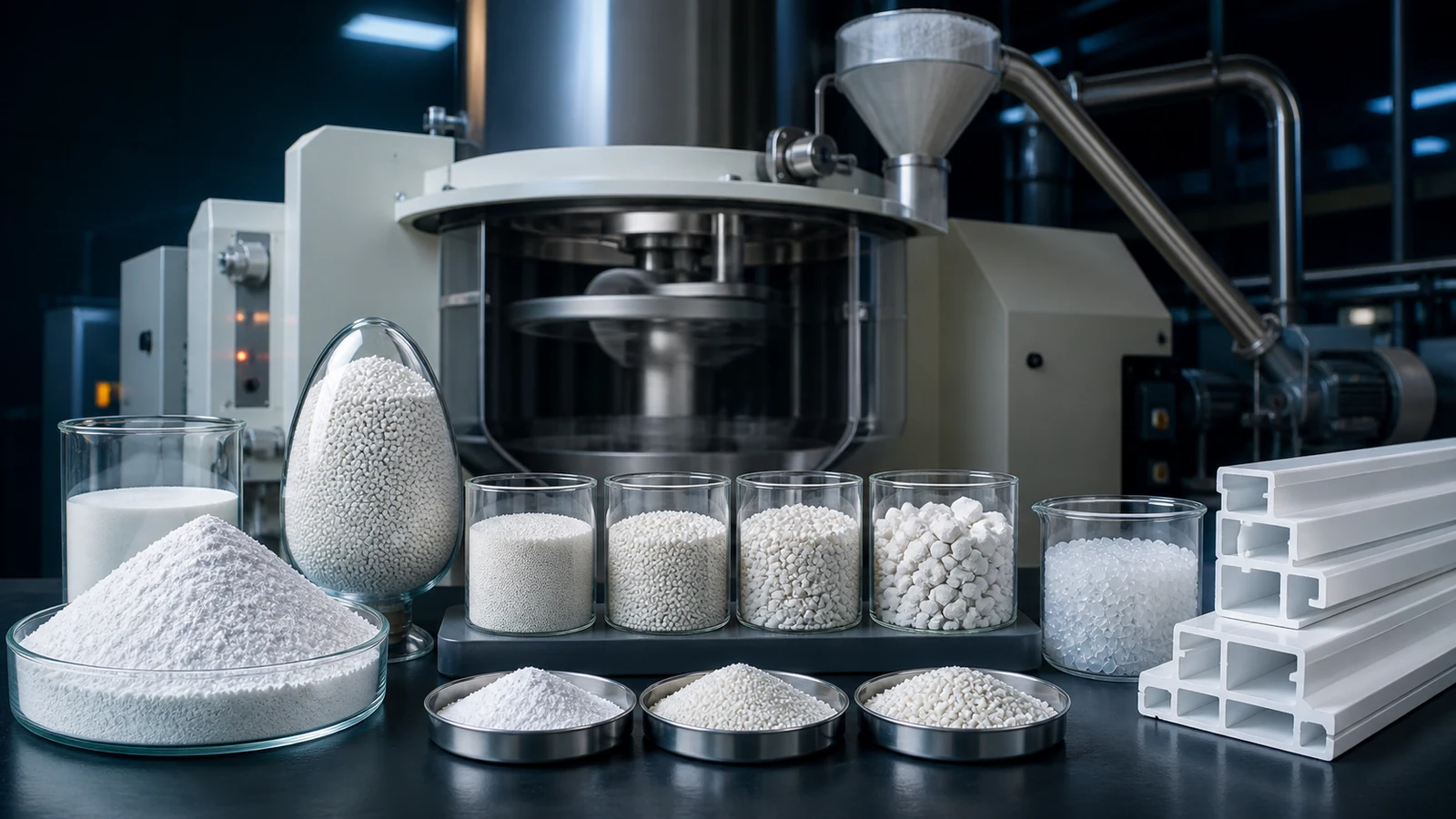
Calcium carbonate (CaCO3) is the most widely used filler in PVC extrusion—and for good reason. At roughly 10–15% of the cost of PVC resin, replacing even 20 phr of resin with CaCO3 can reduce raw material costs by 15–18%. But filler isn't just a cost-cutter: the right CaCO3, at the right particle size and loading, improves dimensional stability, reduces shrinkage, and enhances surface quality for products ranging from PVC wall panels to foam boards.
This guide covers everything you need to know to select and optimize CaCO3 filler for your PVC extrusion process.
1. GCC vs PCC: Two Types of Calcium Carbonate
There are two fundamentally different types of CaCO3 used in PVC:
| Property | Ground Calcium Carbonate (GCC) | Precipitated Calcium Carbonate (PCC) |
|---|---|---|
| Production | Mechanically crushed & ground limestone | Chemically precipitated from Ca(OH)2 + CO2 reaction |
| Particle shape | Irregular, angular fragments | Controlled morphology: scalenohedral, rhombohedral, or spherical |
| Particle size (D50) | 2–50 μm (typical PVC grades: 5–15 μm) | 0.07–2 μm (ultra-fine) |
| Surface area | Low (1–5 m2/g) | High (5–25 m2/g) |
| Oil absorption | 15–20 g/100g | 25–45 g/100g |
| Cost (relative) | 1.0x (baseline) | 2.5–4.0x |
| Typical use in PVC | Standard profiles, pipes, panels | High-gloss profiles, high-impact formulations, transparent/nucleated foam |
When to Use GCC
GCC is the workhorse filler for 90%+ of rigid PVC extrusion applications. At 800–1250 mesh (10–18 μm), stearic acid-coated GCC provides good dispersion, adequate mechanical properties, and the best cost-performance ratio. Use GCC for ceiling panels, skirting boards, cable trunking, and other non-structural profiles.
When to Use PCC
PCC's ultrafine particle size and controlled morphology provide superior impact strength at equivalent loading levels. It's used when surface gloss, high whiteness, or impact resistance at high filler loading is critical. PCC nano-CaCO3 (40–80 nm) acts as both filler and nucleating agent in PVC foam board formulations, promoting finer, more uniform cell structure.
2. Particle Size: The Most Important Parameter
Particle size is measured in mesh (screen opening) or microns (μm). Here's how it maps to application:
| Mesh | Approximate D50 (μm) | Application | Surface Quality | Impact on Strength |
|---|---|---|---|---|
| 400 mesh | 38 μm | Low-cost decorative profiles, drain pipes | Matte, slightly rough | Significant reduction |
| 600–800 mesh | 18–23 μm | Standard wall panels, ceiling panels, door frames | Semi-gloss | Moderate reduction |
| 1000–1250 mesh | 10–13 μm | High-gloss profiles, edge banding, window profiles | High gloss | Minimal reduction |
| 1500–2500 mesh | 5–8 μm | Premium window profiles, high-impact formulations | Excellent gloss | Negligible reduction |
| Nano-CaCO3 (PCC) | 0.04–0.08 μm | Impact modifier replacement, foam nucleator | Excellent | Can improve impact |
Rule of thumb: every 200-mesh increase in CaCO3 fineness adds approximately 10–15% to filler cost but reduces strength loss by ~20%. For indoor decorative profiles, 800 mesh is sufficient. For load-bearing or outdoor profiles, use 1250 mesh or finer.
3. Coated vs Uncoated CaCO3
Stearic acid coating (usually 0.8–1.2% by weight) transforms CaCO3 from a simple extender into a functional filler:
- Uncoated (untreated) CaCO3: High surface energy, hydrophilic, agglomerates easily, poor dispersion in hydrophobic PVC. Results in uneven filler distribution, lower impact strength, and white specks on the surface.
- Coated (activated) CaCO3: The stearic acid monolayer reduces surface energy, making the particles hydrophobic and compatible with PVC. Coated CaCO3 disperses more uniformly, yields better gloss, and can be loaded at higher levels (10–15% more) before mechanical properties deteriorate.
Verification test: Place a spoonful of CaCO3 powder in water. Coated (activated) CaCO3 will float; uncoated CaCO3 will sink and disperse. This simple test catches suppliers who shortchange on coating.
4. Filler Loading Levels by Product Type
| Product | Recommended CaCO3 (phr) | Mesh Size | Rationale |
|---|---|---|---|
| PVC Window Profiles | 5–10 | 1250 mesh | Must maintain impact & weatherability; low loading preserves CPE modifier effectiveness |
| PVC Door Frames | 10–20 | 800–1250 mesh | Moderate structural demand; balanced cost-strength compromise |
| PVC Wall Panels | 20–35 | 800 mesh | Non-structural decorative; higher loading acceptable |
| PVC Ceiling Panels | 25–40 | 800 mesh | Lightweight; higher loading reduces sag under own weight |
| PVC Skirting / Cable Trunking | 30–50 | 600–800 mesh | Cost-driven; minimal structural requirement |
| PVC Foam Board (Celuka) | 5–15 | 1250 mesh + 2–5 phr nano-CaCO3 | Low filler for uniform foam; nano acts as nucleator |
| PVC Edge Banding | 5–12 | 1250 mesh | Requires flexibility & gloss; low filler essential |
| SPC Flooring Core | 150–250 | 400–800 mesh | Extremely high loading for rigidity & cost; SPC = Stone Plastic Composite |
SPC flooring is the extreme case: CaCO3 loading reaches 60–75% by weight. At this level, CaCO3 is not a filler—it is the primary structural component. The PVC resin (25–35%) functions as a binder, not the matrix.
5. How CaCO3 Affects Extrusion Processing
Adding CaCO3 changes processing behavior in several ways:
- Higher thermal conductivity: CaCO3 conducts heat ~5x better than PVC. At loadings above 20 phr, heat transfers faster through the melt, enabling higher output. However, this also increases motor load because the filled melt is more viscous.
- Reduced die swell: CaCO3 reduces the elastic component of the melt, decreasing die swell by 20–40% at 30 phr loading. This is generally beneficial—it makes dimensions more predictable. But if you switch from low-filler to high-filler formulation, the sizing die may need adjustment.
- Increased screw and barrel wear: CaCO3 is abrasive. At loadings above 30 phr, use bimetallic barrels and nitrided screws. Screw life can drop from 3–5 years to 1–2 years on standard nitrided screws at high filler loading.
- Processing temperature: Higher filler content conducts heat away from melt faster. You may need to increase barrel temperatures by 3–5°C to maintain the same melt temperature.
6. Common Filler-Related Problems & Solutions
| Problem | Likely Cause | Solution |
|---|---|---|
| White specks / streaks on surface | Poor dispersion; uncoated or agglomerated CaCO3 | Switch to coated CaCO3; increase mesh fineness; add 0.3 phr stearic acid as dispersing aid |
| Profile too brittle (low impact) | Filler loading too high for application | Reduce CaCO3 by 5–10 phr; switch to finer mesh; increase CPE/impact modifier level |
| Die lip wear / scoring | Abrasive large-particle CaCO3; uncoated filler | Use 1250+ mesh coated CaCO3; specify low-silica-content filler |
| Surface roughness / low gloss | Coarse filler particles protruding through surface | Increase mesh to 1250+; reduce loading; check die temperature is adequate |
| Moisture-related bubbles | CaCO3 absorbs moisture during storage | Pre-dry filler at 80–90°C for 2–3 hours before hot-mixing; store in dry conditions |
| Surging (uneven output) | Bulk density variation; bridging in hopper | Blend different CaCO3 batches; use vibratory feeder; check particle size distribution consistency |
7. Cost Optimization: Finding the Sweet Spot
The economic sweet spot for CaCO3 loading balances three factors:
- Raw material cost savings: Each 10 phr of CaCO3 replacing PVC saves ~8–12% on compound cost.
- Property degradation penalty: Beyond ~30 phr (for standard profiles), impact strength drops sharply. You risk increased customer rejection and warranty claims.
- Equipment maintenance cost: Above 30 phr, accelerated screw/barrel wear adds US$2,000–5,000/year in maintenance costs on a typical 65/132 conical twin-screw line.
For most rigid PVC profiles, the optimal range is 15–25 phr of 800–1250 mesh coated GCC. This provides meaningful cost savings without compromising quality or maintenance costs.
Need Help with Your PVC Filler Formulation?
Our formulation engineers can recommend the optimal CaCO3 grade and loading for your specific product and market.
Get Formulation AdviceRelated Articles & Products
- PVC Formulation Guide for Profile Extrusion
- PVC Stabilizer Selection: Ca-Zn vs Organotin
- Extrusion Line Energy Efficiency Optimization
- Products: PVC Wall Panel Machine | PVC Ceiling Panel Machine
Conclusion
Calcium carbonate is far more than a cheap filler—it's a functional ingredient that, when properly selected (coated, correct particle size, optimal loading), improves product quality while reducing cost. The key is to match the CaCO3 grade to your product requirements: coarse and high-loading for cost-driven decorative profiles; fine and low-loading for structural or high-gloss applications. Remember that CaCO3 quality consistency from your supplier is just as important as the specification—variation in particle size distribution or coating quality from batch to batch will show up as variation in your product.