
Extrusion Line Energy Efficiency: How to Reduce kWh per Kilogram
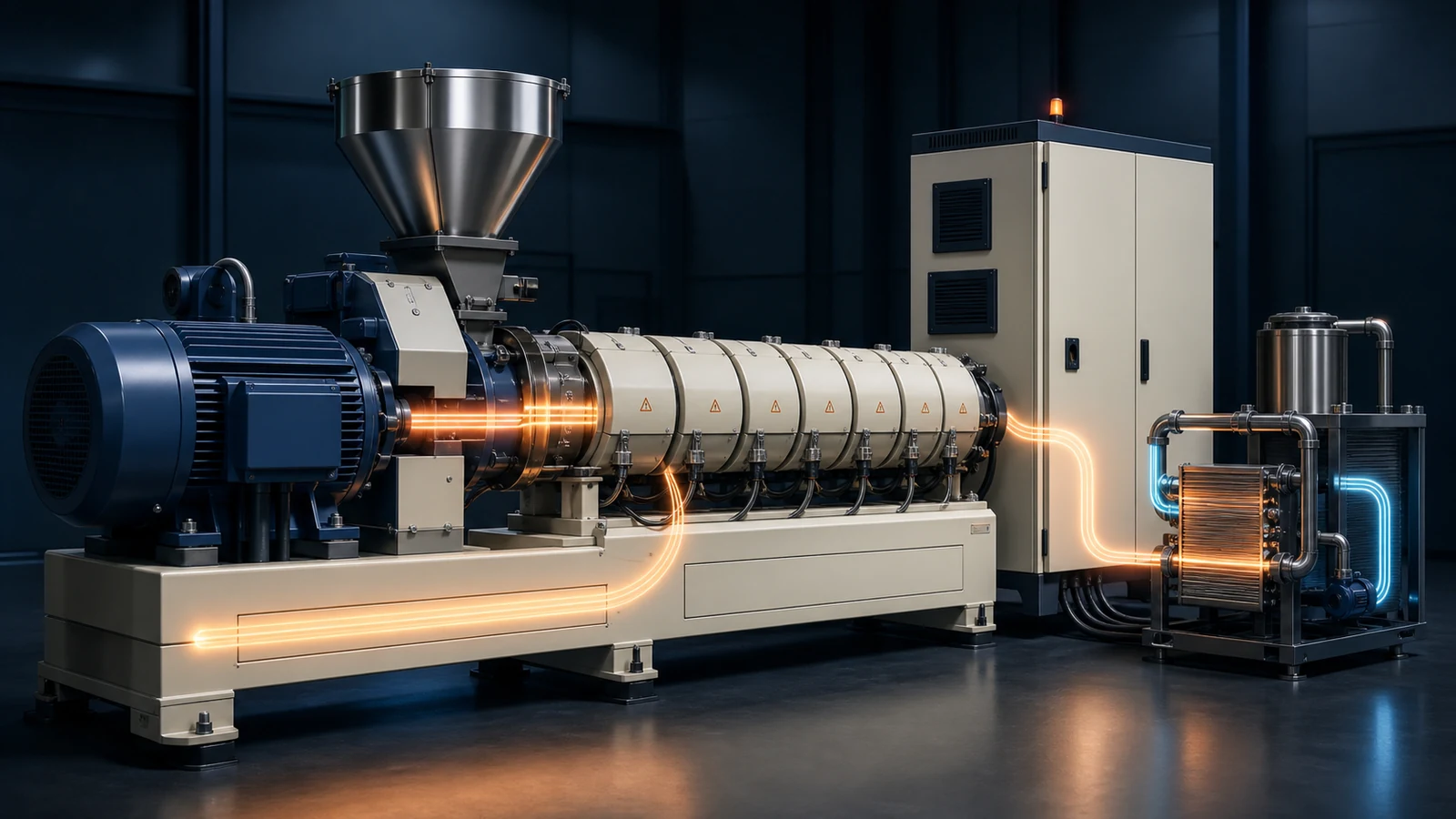
Energy is the second-largest operating cost in PVC extrusion after raw materials. A typical PVC profile extrusion line (SJZ 65/132, 250–400 kg/hr) consumes 120–180 kW of electrical power—roughly US$0.04–0.07 per kilogram at industrial electricity rates. Over a year of continuous production, energy costs range from US$60,000 to US$120,000 per line. Reducing energy consumption by even 15% saves US$9,000–18,000 annually per line.
This guide covers practical, actionable strategies to improve the energy efficiency of your PVC and WPC extrusion lines—from quick wins with immediate payback to longer-term capital investments.
1. Where the Energy Goes: Extrusion Line Energy Audit
| Energy Consumer | % of Total Line Consumption | Typical Power (kW) | Efficiency Improvement Potential |
|---|---|---|---|
| Main extruder motor | 40–55% | 37–75 kW | 10–20% (VFD optimization, screw design) |
| Barrel & die heaters | 15–25% | 20–40 kW | 15–30% (insulation, heat recovery) |
| Vacuum pump | 5–8% | 5.5–11 kW | 20–40% (VSD, vacuum optimization) |
| Cooling system (chiller + pumps) | 8–12% | 10–20 kW | 15–25% (temperature optimization, free cooling) |
| Material handling (mixer, conveying, dryer) | 5–10% | 8–15 kW | 10–15% (scheduling, hot-feed utilization) |
| Puller / haul-off | 3–5% | 3–5.5 kW | 5–10% |
| Ancillary (lighting, compressed air, etc.) | 5–10% | 5–15 kW | 10–20% |
The main extruder drive and the heating system account for 55–80% of total energy consumption. These are where the biggest savings opportunities lie.
2. Quick Wins (Payback <3 Months)
2.1 Barrel and Die Insulation
Uninsulated barrel and die heater bands radiate 15–25% of their heat output directly into the factory air. Installing removable ceramic fiber or mineral wool insulation blankets on the barrel and die:
- Reduces heater duty cycle by 20–35% (insulation retains heat between heater-on cycles)
- Reduces barrel heater energy consumption by 15–25%
- Also improves operator safety and reduces factory air conditioning load
- Material cost: US$500–1,500 per extruder; installation: 1 day
- Payback: 1–3 months at US$0.10/kWh
Barrel insulation is the single highest-ROI energy efficiency investment in extrusion. If you do nothing else, insulate your barrels. A 65/132 extruder with 4 barrel zones + adapter + die has approximately 3–4 m2 of hot exposed surface area at 160–180°C, radiating 2–3 kW continuously into the factory. Insulation recovers most of this.
2.2 Optimize Cooling Water Temperature
Many factories run chillers at 5–10°C "just to be safe," but PVC profiles do not need ice-cold water. Cooling water at 15–20°C provides adequate heat removal for most profile extrusion while saving significant chiller energy:
- Every 5°C increase in chilled water setpoint reduces chiller energy consumption by 12–18%
- Raising from 7°C to 18°C reduces chiller energy by approximately 25–35%
- For calibration/cooling tanks, 20–25°C water is adequate for most profiles; only the final calibrator stage benefits from colder water
2.3 Fix Compressed Air Leaks
Compressed air is the most expensive utility in a factory (costing 8–10x the electricity that powers the compressor, due to inefficiencies). A single 3 mm compressed air leak costs US$1,000–2,000 per year. Walk the line once per quarter with an ultrasonic leak detector and fix every leak.
3. Medium-Term Investments (Payback 3–12 Months)
3.1 Variable-Speed Drive (VSD) on Vacuum Pump
Most calibration vacuum pumps run at full speed with a bleed valve controlling vacuum level—wasting energy. Installing a VSD with vacuum transducer feedback:
- The pump runs only at the speed needed to maintain the vacuum setpoint
- Energy saving: 25–45% on vacuum pump power
- For an 11 kW vacuum pump running 6,000 hours/year at US$0.10/kWh, annual saving = US$1,650–2,970
- VSD cost: US$2,000–4,000 (payback 12–18 months)
- Bonus: quieter operation, longer pump seal life
3.2 Heat Recovery from Hydraulic Oil Cooler
The screw core temperature control system uses oil at 90–120°C that must be cooled. Instead of rejecting this heat to a cooling tower, recover it:
- Pre-heat the PVC dry blend entering the hopper (reducing barrel Zone 1 energy demand)
- Pre-heat building hot water or space heating (in cold climates)
- Heat the calibration tank water (reducing chiller load)
- Energy recovery potential: 5–10 kW per extruder
- Heat exchanger cost: US$3,000–8,000 (payback 6–12 months)
3.3 Hot-Feed Dry Blend (Use Mixer Residual Heat)
PVC dry blend exits the hot mixer at 110–130°C and is cooled in a cooling mixer to 40–50°C before storage. Instead of cooling and then re-heating in the extruder, feed the dry blend warm (50–60°C) directly to the extruder hopper:
- Every 10°C increase in feed temperature reduces Zone 1 heater demand by approximately 5–8%
- Feeding at 50°C instead of 25°C saves 10–15% on Zone 1 heating energy
- Requires insulated hopper and controlled-temperature storage silo
4. Long-Term Strategic Changes (Payback 1–3 Years)
4.1 High-Efficiency Motor + VFD Upgrade
Older extruders (>10 years) typically use IE1 or IE2 efficiency motors. Upgrading to an IE4 (super-premium efficiency) motor with a modern VFD:
| Motor Rating | IE2 Efficiency | IE4 Efficiency | Annual Saving (6,000h @ US$0.10/kWh) |
|---|---|---|---|
| 37 kW (SJZ 65/132) | 92.5% | 94.8% | US$480/year |
| 55 kW (SJZ 80/156) | 93.0% | 95.2% | US$736/year |
| 75 kW (SJZ 92/188) | 93.6% | 95.6% | US$900/year |
Motor efficiency alone has modest payback. The real savings come from the VFD, which enables:
- Running at the optimal RPM for each product (avoiding oversized motor at partial load)
- Soft-start capability (eliminates inrush current surge)
- Power factor correction (improves overall electrical efficiency)
Combined motor + VFD upgrade payback: 1–3 years for motors above 37 kW.
4.2 Screw Design for Energy Efficiency
The screw design directly determines how much mechanical energy is converted to melt heating (desirable) vs. wasted as excessive shear (undesirable). An energy-efficient screw design:
- Optimizes compression ratio for the specific formulation (lower compression = less shear heating = lower motor load, but must ensure adequate gelation)
- Uses barrier flights to separate melt from unmelted solids, improving heat transfer efficiency
- Reduces energy consumption by 8–15% compared to a standard general-purpose screw at the same output
- Investment: US$8,000–15,000 for a custom-designed screw set; payback 12–24 months
Screw design is a trade-off between energy efficiency and processing flexibility. An energy-optimized screw for a narrow range of formulations can save 15% on energy but may struggle if you frequently switch between very different compounds. Match the screw to your primary product/ formulation. If you run 80% wall panels and 20% miscellaneous profiles, optimize for wall panels.
5. Production Scheduling for Energy Efficiency
5.1 Minimize Startups
For a measured cold-start heater consumption of 15–30 kWh and an electricity tariff of US$0.10/kWh, the heater electricity cost is US$1.50–3.00 per startup. Calculate motor and auxiliary electricity, labor, startup scrap and lost production separately from metered usage and actual costs. Startup duration and scrap depend on the line and formulation; use production records when planning longer campaigns.
5.2 Sequence Products by Processing Temperature
When multiple products must run on the same line, sequence them in order of decreasing processing temperature. This minimizes the energy wasted in heating and cooling the system between product changes:
- Start with the highest-temperature product (e.g., filled compound at 175–180°C)
- Transition to progressively lower-temperature products
- This avoids the energy cost of heating up, cooling down, then heating up again
- Energy saving: 5–10% on days with product changeovers
5.3 Zone Heating on Standby
During production breaks (shift changes, lunch, minor maintenance), don't keep the extruder at full production temperature. Implement a "standby mode":
- Reduce all barrel and die temperatures by 20–30°C (to 130–140°C)
- Stop screw rotation (if no material in barrel)
- Recovery to production temperature takes 10–15 minutes vs. 30–60 minutes from cold
- For a 2-hour break, energy saving is 15–25 kWh (US$1.50–2.50 per break)
6. Measuring and Tracking Energy Efficiency
You can't manage what you don't measure. Install an energy meter on each extrusion line and track the KPI: kWh per kilogram of finished product.
| Product Type | Typical kWh/kg (Well-Optimized Line) | Poor kWh/kg (Indicates Inefficiency) |
|---|---|---|
| Rigid PVC profiles (standard) | 0.30–0.40 kWh/kg | >0.50 kWh/kg |
| Rigid PVC profiles (foamed) | 0.35–0.45 kWh/kg | >0.55 kWh/kg |
| PVC foam board (Celuka) | 0.35–0.50 kWh/kg | >0.60 kWh/kg |
| SPC flooring core sheet | 0.25–0.35 kWh/kg | >0.45 kWh/kg |
| WPC decking (PE-based) | 0.40–0.55 kWh/kg | >0.65 kWh/kg |
| WPC (PVC-based, foamed) | 0.45–0.60 kWh/kg | >0.70 kWh/kg |
Track this metric weekly. A sustained increase in kWh/kg without a corresponding increase in output means something has changed: screw/barrel wear, heater band failure, or a process issue that should be investigated.
For SPC flooring lines, note that kWh/kg is unusually low (0.25–0.35) because of the extreme filler loading. The output in kg/hr is very high (CaCO3 is dense) relative to the extruder size, which improves the kWh/kg metric. Don't compare SPC kWh/kg directly to unfilled PVC profiles.
7. Total Potential Savings Summary
| Measure | Energy Saving | Investment | Payback | Annual Saving (1 line, 6,000h, US$0.10/kWh) |
|---|---|---|---|---|
| Barrel/die insulation | 5–10% | ~US$1,000 | 1–3 months | US$4,500–9,000 |
| Cooling water temp optimization | 3–5% | US$0 (control change) | Immediate | US$2,700–4,500 |
| VSD on vacuum pump | 3–5% | US$3,000 | 12–18 months | US$2,700–4,500 |
| Heat recovery | 2–4% | US$5,000 | 6–12 months | US$1,800–3,600 |
| Hot-feed dry blend | 2–3% | US$2,000 | 3–6 months | US$1,800–2,700 |
| Production scheduling | 2–5% | US$0 (process change) | Immediate | US$1,800–4,500 |
| Energy-optimized screw | 8–15% | US$12,000 | 12–24 months | US$7,200–13,500 |
| Total potential savings | 15–30% | US$0–23,000 | — | US$12,000–42,000/year/line |
Want an Energy Audit for Your Extrusion Line?
Our process engineers can conduct an on-site energy assessment and provide a customized efficiency improvement plan with quantified ROI.
Request Energy AuditRelated Articles
- PVC Temperature Control Extrusion Guide
- Screw & Barrel Maintenance Guide
- Conical vs Parallel Twin Screw Extruder
- PVC Recycling & Regrind Processing Guide
Conclusion
Energy efficiency in PVC extrusion is a journey, not a destination. Start with the no-cost and low-cost measures: insulate your barrels, optimize your cooling water and vacuum systems, and improve production scheduling. These alone can deliver 10–15% reduction in kWh/kg with payback measured in weeks or months. Then tackle the medium-term investments (VSDs, heat recovery) and, when the time comes for screw replacement, specify an energy-optimized design. Track kWh/kg weekly for each line and make energy efficiency a visible KPI on the production floor. A factory with 5 extrusion lines that reduces energy consumption by 20% saves US$60,000–150,000 annually—that's profit that drops straight to the bottom line.