
PVC Recycling & Regrind Processing Guide: Post-Industrial Reuse
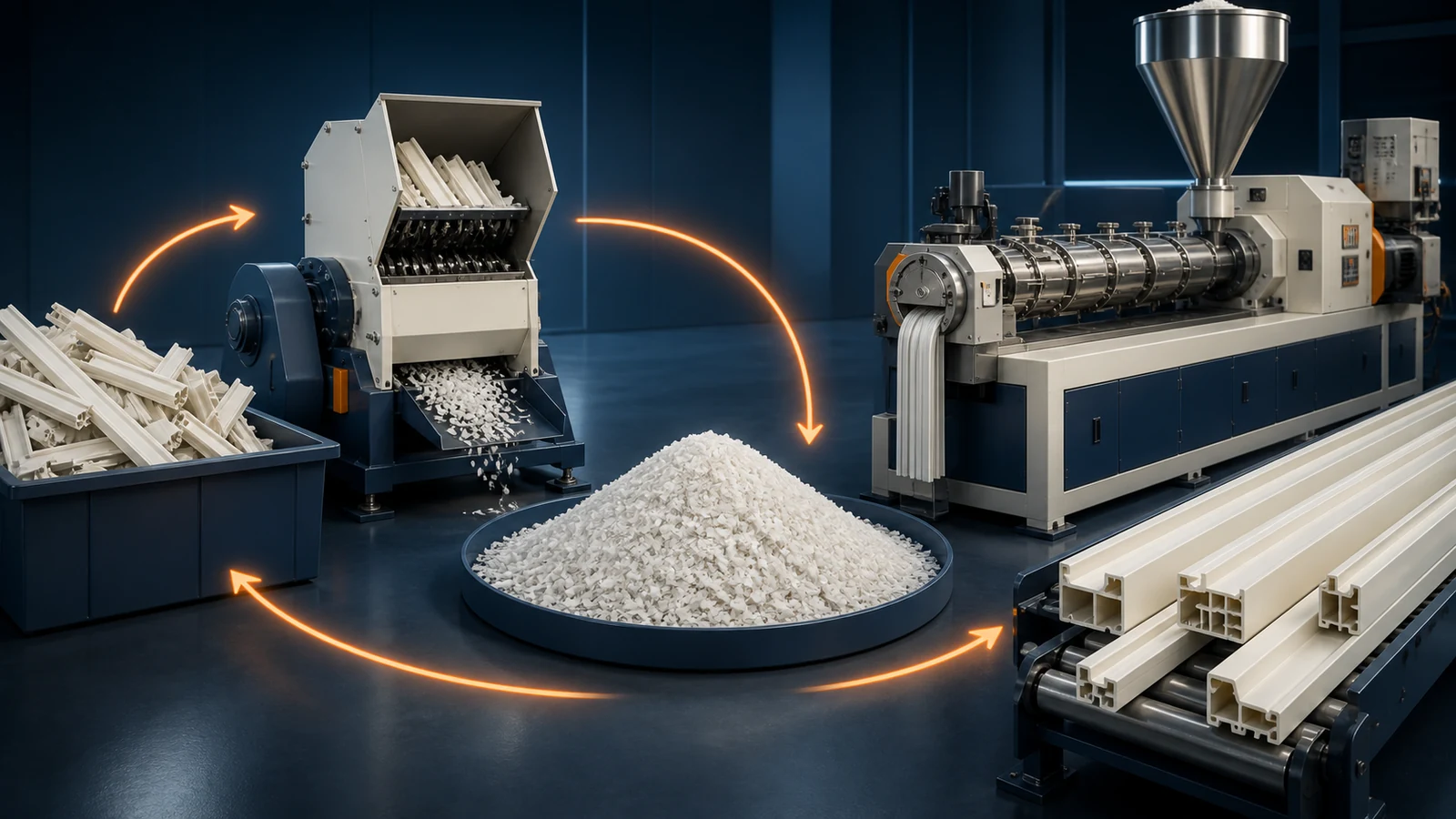
A PVC extrusion line generates 3–8% waste: startup scrap, off-spec product, trim, and purging material. At a raw material cost of US$800–1,200 per ton for PVC compound, a mid-size factory producing 200 tons/month loses US$5,000–20,000/month to waste—if that waste goes to landfill. By processing regrind back into production, you convert a cost center into raw material savings.
This guide covers how to recycle post-industrial PVC scrap back into your extrusion process—safely, economically, and without compromising product quality on PVC profiles, sheets, and WPC products.
1. Types of Recyclable PVC Waste
| Waste Type | Source | Quality | Best Reuse Strategy |
|---|---|---|---|
| Post-industrial regrind (PIR) | Startup scrap, off-spec product, edge trim, out-of-tolerance profiles | High—known formulation, single source, no contamination | Grind and blend back into same product at 10–30% |
| Post-industrial purge material | Purging compound + PVC residue from extruder cleaning | Medium—mixed with non-PVC purging material | Segregate PVC-only purge; avoid mixing with PE/PP-based purge |
| Post-consumer recycled (PCR) | Used window profiles, pipes, flooring (end-of-life products) | Low to medium—unknown formulation, potential contamination, degraded stabilizer | Use only in non-visible, non-structural products; separate by type (rigid vs. flexible) and color |
| Production floor sweepings | Sawdust and fines from cutting/sawing stations | Low—mixed with dust, grit, floor contaminants | Sell to recycler; do not use in primary production |
Post-industrial regrind is "gold." Post-consumer recycled PVC is "copper." Floor sweepings are "dirt." Don't mix them. Segregate waste streams at the source—label collection bins clearly by material type and color. The value of segregated regrind is 2–3x that of mixed scrap.
2. The Regrind Processing Chain
Step 1: Collection & Segregation
Collect waste at each production station in labeled containers. Segregate by:
- Material type: Rigid PVC, flexible PVC, WPC, purge material. NEVER mix rigid and flexible PVC—even 2% flexible PVC in a rigid compound ruins impact strength.
- Color: White, cream, mixed colors. White regrind is most valuable (can go into white or colored products). Dark regrind only into dark products or the core of co-extruded profiles.
- Co-extruded vs. single-layer: Co-extruded scrap with a different cap layer formulation should be tracked separately.
Step 2: Size Reduction (Grinding)
PVC profiles and sheets must be ground to a particle size compatible with the extrusion feed system:
| Grinder Type | Output Particle Size | Throughput | Best For |
|---|---|---|---|
| Low-speed granulator (25–150 RPM) | 3–8 mm | 100–500 kg/hr | Profiles, thick sheets; generates less dust and heat |
| High-speed granulator (400–600 RPM) | 1–5 mm | 200–1,000 kg/hr | Thin sheets, edge trim; higher throughput, more dust |
| Pulverizer / disc mill | 0.3–1.0 mm (powder) | 50–200 kg/hr | High regrind loading (>30%); improves dry blend homogeneity |
Key grinding parameters:
- Screen size: 4–8 mm screen for standard profiles; 2–4 mm for thin-wall or high-regrind applications
- Knife maintenance: Dull knives produce irregular particles and excessive fines. Rotate/replace every 50–100 tons of material.
- Dust control: Connect a cyclone dust collector. PVC dust (<0.5 mm) is a respiratory irritant and causes feeding inconsistency.
Step 3: Metal Separation
Metal contamination (staples, screws, nails, tool fragments) can destroy a screw-barrel set. Install a three-stage metal separation system:
- Magnetic separator (drum or plate magnet): Removes ferrous metals before grinding
- Eddy current separator (optional): Removes non-ferrous metals (aluminum, copper, brass)
- Metal detector on conveyor: Final check before material enters the silo/hopper
3. Formulation Adjustments for Regrind
Adding regrind changes your formulation because the regrind already contains stabilizer, lubricant, filler, and processing aids from its first pass through the extruder. A second heat history further consumes the residual stabilizer.
Stabilizer Compensation
Each heat history consumes 15–25% of the original stabilizer effectiveness. For regrind containing 3.5 phr Ca-Zn stabilizer (original), after one extrusion pass, the effective residual stabilizer is approximately 2.6–3.0 phr. When adding 20% regrind:
- Increase virgin compound stabilizer by 0.2–0.4 phr in the virgin portion (effectively adding stabilizer for the whole blend)
- OR add 0.1–0.2 phr additional stabilizer to the total blend
Lubricant Adjustment
Regrind has gone through one heat/shear cycle. Some lubricant is consumed (oxidized, volatilized). External lubricant consumption is typically 10–20% per pass.
- For 10–20% regrind: No lubricant adjustment needed (variation absorbed by normal processing window)
- For 20–40% regrind: Add 0.05–0.10 phr external lubricant to compensate
- For >40% regrind: Consider a separate "recycled blend" formulation with a higher stabilizer and lubricant package specifically designed for regrind-rich blends
Physical Property Impact
| Regrind Content | Impact Strength Change | Tensile Strength Change | Color Shift |
|---|---|---|---|
| 10% | −2–5% (negligible) | Negligible | Barely detectable (ΔE <0.5) |
| 20% | −5–10% | −2–5% | Slight yellowing (ΔE 0.5–1.5) |
| 30% | −10–20% | −5–8% | Noticeable yellowing (ΔE 1.5–3.0) |
| 50% | −20–35% | −8–15% | Significant yellowing (ΔE >3.0) |
The 30% rule: For visible-surface applications, limit regrind to 30% maximum. The impact strength loss becomes unacceptable for most structural profiles, and the color shift becomes commercially noticeable. For non-visible cores in co-extruded products, regrind content can reach 50–70% with proper formulation adjustment.
4. Co-extrusion: The Best Use Case for Regrind
Co-extrusion with a virgin skin and recycled core is the economically optimal way to use high percentages of regrind. The virgin skin provides the surface quality, color, and weatherability; the recycled core provides bulk at low cost. This is standard practice in window profile manufacturing, where the core can contain 30–70% regrind with a 0.5–1.0 mm virgin cap layer.
Economic analysis for a window profile line producing 100 tons/month:
| Scenario | Virgin Compound (70%) | Regrind (30%) | Monthly Material Cost | Annual Saving |
|---|---|---|---|---|
| 0% regrind (baseline) | 100% at US$1,000/t = US$100,000 | 0 | US$100,000 | US$0 |
| 30% core regrind (co-ex) | 70% at US$1,000/t = US$70,000 | 30% at US$200/t (grinding cost) = US$6,000 | US$76,000 | US$288,000 |
| 50% core regrind (co-ex) | 50% at US$1,000/t = US$50,000 | 50% at US$200/t = US$10,000 | US$60,000 | US$480,000 |
The co-extrusion die and extra extruder investment (US$30,000–50,000) pays back in 2–4 months at these savings rates.
5. Quality Control for Regrind-Containing Products
Implement these quality checks when running regrind:
- Melt flow stability test: Run the extruder at fixed RPM with 100% virgin, then with the regrind blend. Output (kg/hr) and motor load should be within ±5% of the virgin baseline. Larger deviation suggests inconsistent regrind particle size or contamination.
- Color consistency (spectrophotometer): Measure ΔE between 100% virgin and regrind-blend product every shift. A ΔE trend that increases over time indicates regrind batch variation or progressive thermal degradation.
- Impact test (drop weight or Izod): Test one sample per shift against the virgin baseline. Any drop >15% triggers investigation.
- Thermal stability test (static oven, 190°C): Expose a regrind sample to 190°C and record time to first color change. Should be at least 70% of the virgin compound's stability time.
6. Common Regrind Problems & Solutions
| Problem | Cause | Solution |
|---|---|---|
| Black specks in product | Degraded PVC from previous pass; over-stabilized regrind burned during grinding | Check grinder knife sharpness (dull knives generate heat); check if startup scrap is excessively degraded |
| Color variation between batches | Regrind color non-uniform; mixing different production batches | Blend regrind from multiple batches in a homogenizing silo before use; test color on each batch |
| Gelation problems (unmelted particles) | Regrind particles too large for the extruder to fully re-plasticize | Use pulverizer to reduce regrind to <3 mm; increase barrel Zone 2–3 temperatures by 3–5°C |
| Feed bridging in hopper | Irregular regrind particle shape causes bridging; bulk density lower than virgin dry blend | Mix regrind with virgin dry blend in a ribbon blender before feeding; use crammer feeder |
| Contamination (foreign material in regrind) | Inadequate segregation; floor sweepings mixed in; cross-contamination from other materials | Improve collection bin labeling; train operators on segregation; install metal detectors |
Want to Maximize Your PVC Recycling ROI?
Our engineers can audit your waste streams and design a regrind processing system tailored to your product mix and production volume.
Request Recycling AuditRelated Articles & Products
- PVC Co-extrusion Technology Guide — the ideal technology for virgin-skin/recycled-core products
- PVC Formulation Guide for Profile Extrusion
- PVC Stabilizer Selection: Ca-Zn vs Organotin
- Products: PVC Window Profile Machine | PVC Wall Panel Machine | PVC Ceiling Panel Machine
Conclusion
PVC regrind recycling is not optional—it's a core component of a profitable extrusion operation. The economics are compelling: every percentage point of regrind you successfully incorporate saves US$800–1,000 per ton in virgin compound cost. The key to success is segregation (keep waste streams clean and identified), proper grinding (consistent particle size, sharp knives, dust control), and disciplined formulation adjustment (stabilizer and lubricant compensation). For the highest regrind utilization, invest in co-extrusion capability—putting recycled material in the core and virgin material on the visible surfaces gives you the best of both worlds: low cost and high quality.