
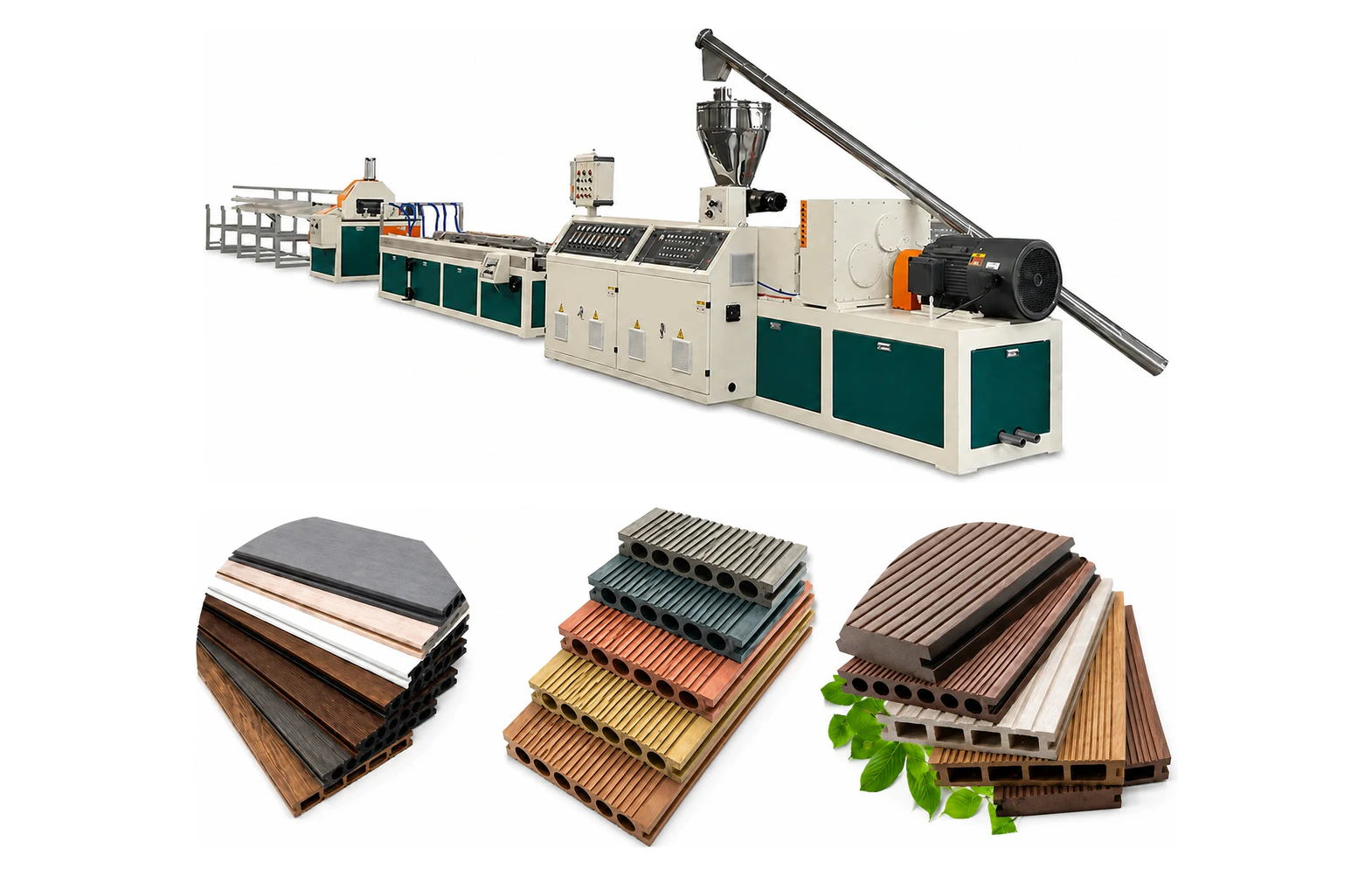
WPC Decking Machine
Product Overview
The WPC Decking Machine produces wood-plastic composite decking boards for outdoor flooring applications. Using PE or PP as the plastic matrix (rather than PVC) with 50-60% wood flour content, these boards offer the natural appearance of wood with superior weather resistance, minimal maintenance, and no rotting or splintering.
The line features a parallel twin-screw extruder (SJZ-80/156) specifically designed for PE/PP-based WPC compounds, which require higher processing temperatures (180-200°C) than PVC-based WPC. The extruder feeds a hollow or solid decking profile die, followed by online embossing for wood grain texture and UV stabilizer application.
Outdoor WPC decking must withstand years of UV exposure, moisture cycling, temperature variation, and mechanical wear. Our formulation guidance includes UV stabilizer packages, coupling agents for wood-plastic bonding, and anti-fungal additives that ensure 10-15 year outdoor service life in moderate climates.
The online embossing system creates realistic wood grain textures synchronized with the board color, providing both visual appeal and anti-slip properties. The deep-textured surface also helps conceal minor scratches and wear marks that develop over years of foot traffic.
Key Features
Parallel twin-screw extruder for PE/PP WPC
Hollow or solid decking profile die
Online embossing for wood grain texture
UV stabilizer feeding system
Cutting and packaging
Production Process
From raw material to finished product — each step is engineered for quality and efficiency.
Wood Flour Processing
Wood flour (40-60 mesh) is dried to <1% moisture. PE/PP pellets, wood flour, coupling agent (MAH-g-PE), UV stabilizers, and pigments are mixed in a high-speed mixer.
Parallel Twin-Screw Extrusion
The WPC compound is processed at 180-200°C in the parallel twin-screw extruder. The screw design provides excellent mixing and venting for the high-wood-content formulation.
Profile Die Forming
The molten WPC exits through a hollow or solid decking profile die. Hollow profiles reduce weight and material cost; solid profiles provide maximum strength for commercial applications.
Calibration & Cooling
Vacuum calibration fixes the profile dimensions while cooling tanks bring the board to handling temperature. Adequate cooling is critical to prevent post-extrusion warping.
Embossing
A heated embossing roll presses a wood grain texture into the surface. The texture provides aesthetic appeal and anti-slip properties for outdoor decking safety.
Cutting & Surface Treatment
Boards are cut to standard lengths (2.2m, 2.9m, 3.6m). Optional UV coating or brush sanding provides additional surface protection or matte finish.
Technical Specifications
| Extruder Model | SJZ-80/156 (parallel twin-screw) |
|---|---|
| Decking Width | 100mm - 150mm |
| Decking Thickness | 20mm - 30mm |
| Wood Powder Content | 50-60% |
| Production Speed | 1-3 m/min |
| Total Power | ~120-180 kW |
Why Choose Wings Plastic
PE/PP Parallel Twin-Screw
Parallel twin-screw extruder is specifically designed for PE/PP-based WPC with higher temperature capability (200°C) and better mixing for high wood flour content (50-60%).
UV & Anti-Fungal Package
Formulation includes UV absorbers, HALS (hindered amine light stabilizers), and zinc borate anti-fungal agents — ensuring 10-15 year outdoor durability in moderate climates.
Hollow & Solid Profiles
Die system produces both hollow profiles (lighter, lower cost, residential) and solid profiles (stronger, commercial, high-traffic) from the same extruder with die changes.
Deep Embossing Texture
Heated embossing creates deep wood grain texture that provides anti-slip safety and conceals minor wear — maintaining appearance over years of outdoor foot traffic.
Coupling Agent Technology
Maleic anhydride grafted PE coupling agent chemically bonds wood fibers to the plastic matrix, improving flexural strength by 40-60% and reducing water absorption.
Quality Assurance
Every production line undergoes rigorous quality verification before delivery:
- Flexural strength tested per ASTM D790 to verify structural adequacy
- Water absorption tested (24h immersion, target <3%) to verify moisture resistance
- UV accelerated weathering (QUV 2000h) to verify color retention and surface integrity
- Slip resistance tested per ASTM D2394 for decking safety compliance
Typical Applications
Frequently Asked Questions
Properly formulated WPC decking lasts 10-15 years in moderate climates and 7-10 years in high-UV tropical climates. The main degradation mode is surface fading and minor cracking, not structural failure.
PE is most common (good moisture resistance, lower cost). PP offers higher stiffness and heat resistance. PVC provides better flame retardancy and paintability. For outdoor decking, PE-based WPC is the industry standard.
WPC decking surfaces can reach 50-65°C in direct sunlight (similar to wood). Lighter colors reduce heat absorption. We recommend testing surface temperature in your target market climate before finalizing color selection.
Yes, WPC decking uses similar joist spacing (400-500mm), fastening methods (hidden clips or face screws), and cutting tools as wood decking. Special WPC screws with pre-drilling are recommended to prevent mushrooming.
Related Products
Related Technical Articles
Ready to Get Started?
Contact our team for a customized WPC Decking Machine solution tailored to your production needs.
Contact Us