
WPC Formulation: Wood Powder Ratio Guide
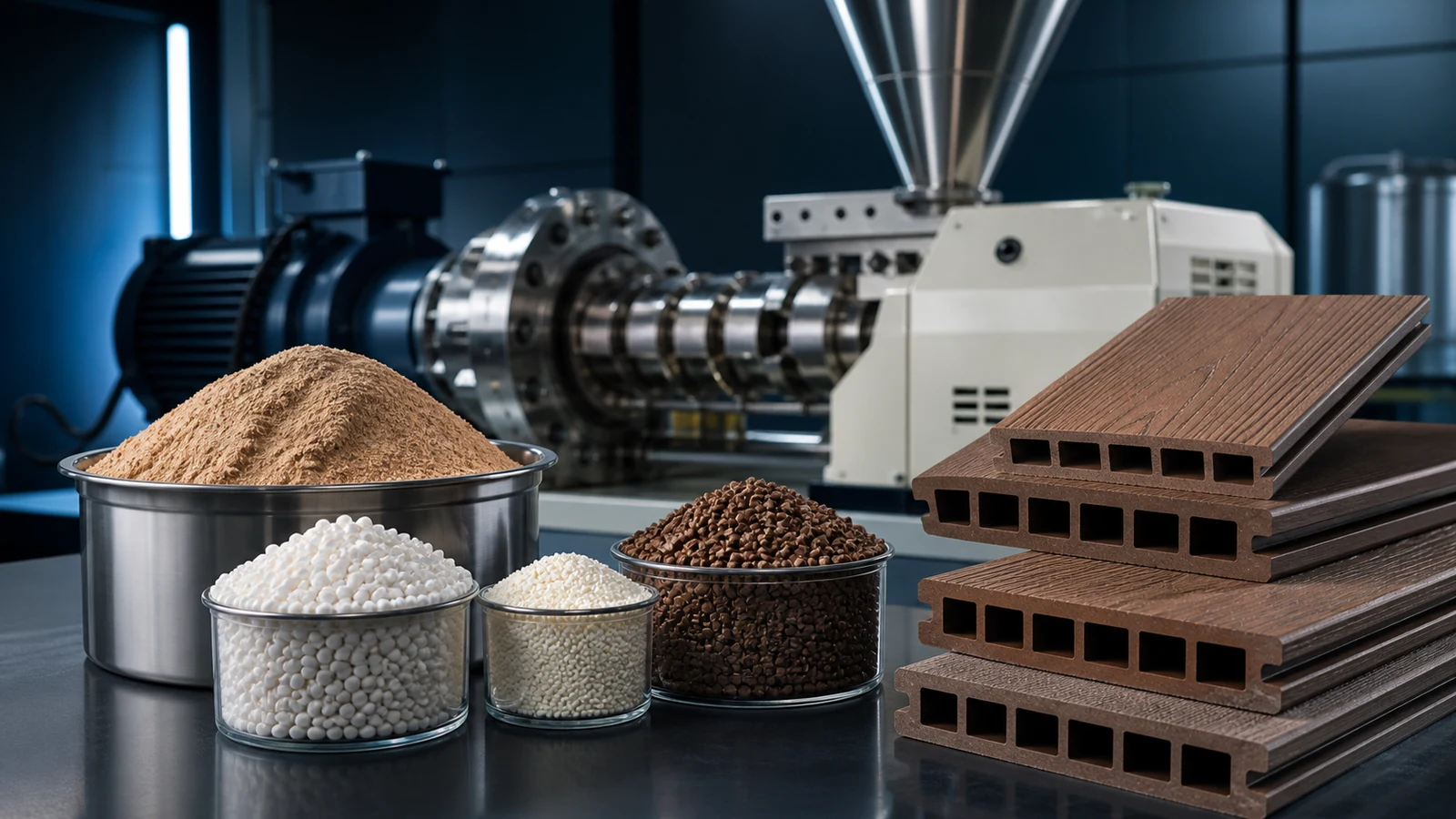
Wood Plastic Composite (WPC) formulation is a delicate balance between polymer, wood fiber, additives, and cost. Getting the wood powder ratio right is critical for achieving the mechanical strength, moisture resistance, and processability that your WPC products need.
Whether you're producing WPC doors, decking, wall panels, or cladding, this guide will help you optimize your formulation.
1. Polymer Matrix: PVC vs PE/PP
WPC products use either PVC or PE/PP as the polymer matrix. The choice depends on the application:
| Property | PVC-Based WPC | PE/PP-Based WPC |
|---|---|---|
| Best for | Indoor (doors, wall panels) | Outdoor (decking, fencing) |
| Wood content | 30-50% | 50-60% |
| UV resistance | Moderate (needs additives) | Poor (needs more UV stabilizers) |
| Moisture resistance | Good | Excellent |
| Processing temp | 160-190°C | 170-200°C |
| Extruder type | Conical twin-screw | Parallel twin-screw |
2. Wood Powder: The Key Variable
Wood Species
The wood species affects both processing and final product properties:
- Pine: Most common, good balance of fiber length and availability
- Poplar: Lighter color, lower density, good for PVC-based WPC
- Eucalyptus: Hardwood, higher density, better mechanical properties
- Bamboo: Excellent strength, increasingly popular for premium WPC
Particle Size (Mesh)
Wood powder particle size significantly impacts WPC quality:
- 60-80 mesh (180-250 μm): Lower cost, rougher surface, adequate for structural products
- 100-120 mesh (120-150 μm): Good balance of cost and quality, most commonly used
- 150-200 mesh (75-100 μm): Premium surface finish, higher cost, best for visible surfaces
For most WPC applications, 100-120 mesh wood powder provides the best balance of cost, surface finish, and mechanical properties. Always use screened and de-dusted powder.
Moisture Content
Moisture is the enemy of WPC processing. Wood powder naturally contains 8-15% moisture, which must be reduced to below 2% before extrusion:
- Air-drying: Reduces to 8-10% (not sufficient)
- Hot air drying (80-100°C): Reduces to 3-5%
- Compounding/pelletizing: Best method — pre-dry wood powder, compound with polymer, then pelletize. Pellets have <1% moisture and can be stored.
Critical: If you're using a direct extrusion process (powder → extruder → product), you MUST pre-dry the wood powder to <2% moisture. Excess moisture causes foaming, surface defects, and reduced mechanical strength.
3. Optimal Wood Powder Ratios
The wood-to-polymer ratio is the most important formulation decision. Higher wood content reduces cost but decreases strength and processability:
| Wood Content | Polymer Content | Best For | Properties |
|---|---|---|---|
| 30-40% | 60-70% | PVC WPC doors, wall panels | High strength, good processability, premium quality |
| 40-50% | 50-60% | PVC WPC foam boards, flooring | Balanced cost and performance |
| 50-60% | 40-50% | PE/PP WPC decking, fencing | Lower cost, good outdoor durability |
| 60-70% | 30-40% | Low-cost WPC products | Lowest cost, reduced strength, harder to process |
4. Coupling Agents: Essential for Strength
Wood fiber and polymer are inherently incompatible — without coupling agents, the bond between them is weak. Coupling agents improve interfacial adhesion, resulting in:
- Up to 50% improvement in tensile strength
- Up to 100% improvement in impact strength
- Better moisture resistance
- Improved surface finish
Common coupling agents:
- MAPP (Maleic Anhydride grafted PP): For PE/PP-based WPC. Dosage: 2-5%
- MAPE (Maleic Anhydride grafted PE): For PE-based WPC. Dosage: 2-5%
- Silane coupling agents: For PVC-based WPC. Dosage: 0.5-2%
Setting Up a WPC Production Line?
We provide complete WPC extrusion lines with formulation support, from wood powder processing to final product.
Get a WPC Production Quote5. Sample Formulation: PVC-Based WPC Door
| Component | Dosage (phr) | Function |
|---|---|---|
| PVC Resin (SG-5) | 100 | Base polymer |
| Wood Powder (120 mesh, <2% moisture) | 80 | Wood fiber (≈44% of total) |
| Ca-Zn Stabilizer | 4 | Thermal stability |
| ACR Processing Aid | 3 | Fusion and melt strength |
| CPE Impact Modifier | 8 | Impact resistance |
| Silane Coupling Agent | 1.5 | Wood-polymer adhesion |
| Internal Lubricant | 1 | Melt flow |
| External Lubricant (PE Wax) | 1.5 | Release (higher for WPC) |
| CaCO3 (coated) | 15 | Filler |
| Pigment | As needed | Color |
6. Common WPC Formulation Problems
- Brittleness: Wood content too high, insufficient coupling agent, or wood powder too coarse
- Poor surface finish: Wood powder too coarse, insufficient lubricant, or moisture in blend
- Foaming/bubbles: Excess moisture in wood powder — pre-dry to <2%
- Low output / motor overload: Wood content too high for extruder capacity, or insufficient lubricant
- Fade/yellowing: Insufficient UV stabilizer, or processing temperature too high
Conclusion
WPC formulation requires careful balancing of wood content, polymer type, coupling agents, and processing parameters. Start with a proven formulation like the one above, then adjust based on your specific product requirements and raw material availability.
For more WPC technical insights, check out our articles on extruder selection for WPC and WPC surface treatment. Or explore our complete range of WPC extrusion machines.