
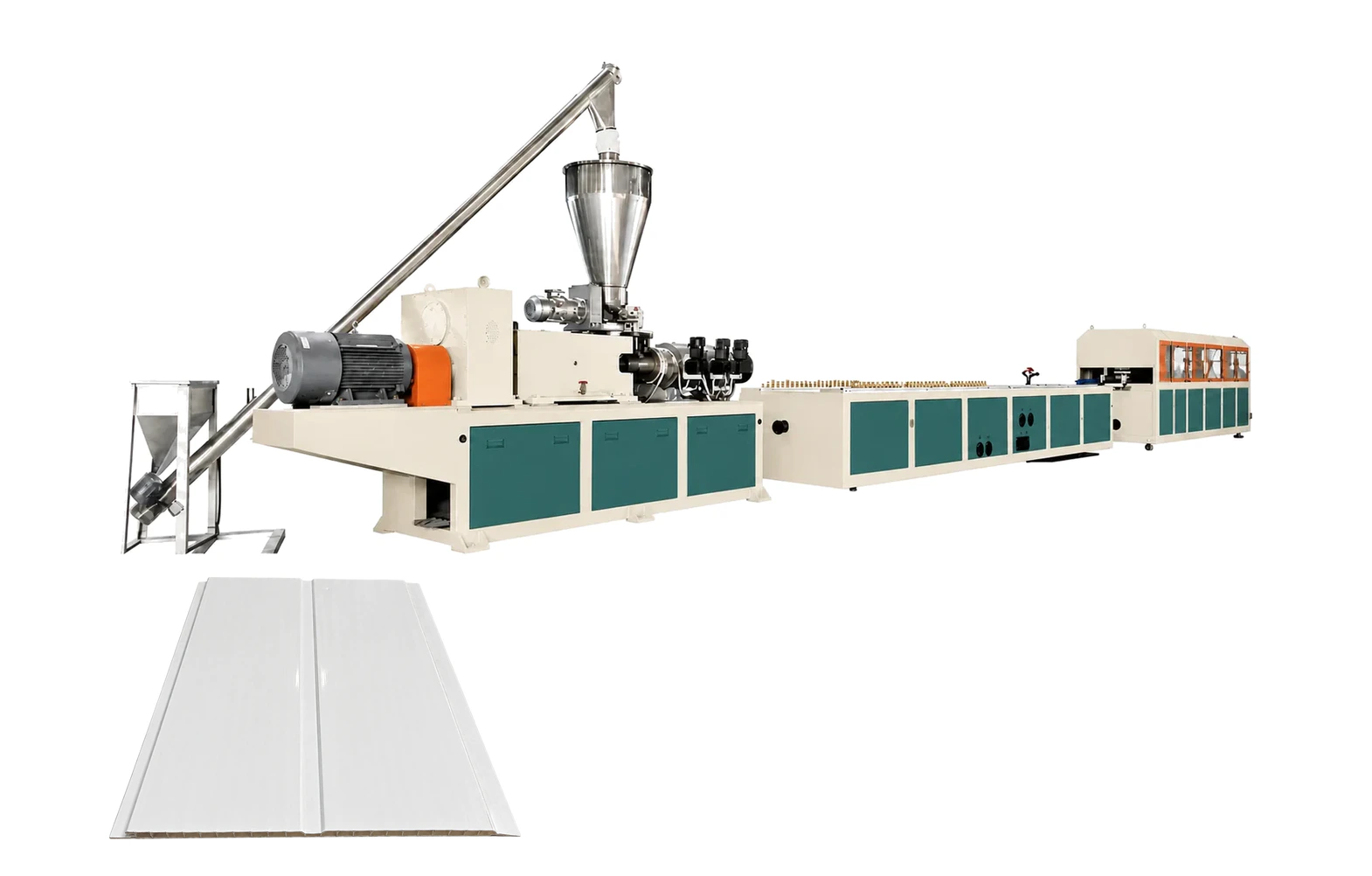
PVC Ceiling Panel Machine
Product Overview
The PVC Ceiling Panel Extrusion Line is specialized for producing narrow-width (200-300mm) PVC ceiling panels used in kitchen, bathroom, and corridor ceiling systems. These panels are valued for their waterproof properties, easy installation via tongue-and-groove connections, and decorative surface finishes that mimic wood, metal, or marble.
This production line uses an SJSZ-65/132 conical twin-screw extruder paired with a precision profile die, vacuum calibration table, and online decoration station. The compact line layout (approximately 22 meters) makes it suitable for facilities with limited floor space while still delivering production speeds of 5-10 m/min.
Ceiling panels require specific formulation adjustments compared to wall panels — typically with higher impact modifier content and UV stabilizers for panels used in sunlit areas. Our formulation guidance helps customers optimize their recipes for different ceiling applications, ensuring long-term color stability and mechanical performance.
The line includes an integrated heat transfer printing unit that applies decorative patterns directly during extrusion. This single-pass production approach reduces manufacturing costs and ensures superior pattern adhesion compared to post-extrusion decoration methods.
Key Features
Single or conical twin-screw extruder
Heat transfer printing unit
Online film lamination station
Vacuum calibrator with multi-zone cooling
Fly-cut saw with automatic stacking
Production Process
From raw material to finished product — each step is engineered for quality and efficiency.
Compound Mixing
PVC resin (SG-5 type), Caco3, stabilizers, CPE impact modifier, and pigments are mixed in a high-speed mixer at 120°C, then cooled to 45°C in a cold mixer.
Extrusion Plasticizing
The compound feeds into the conical twin-screw extruder where it melts at 165-185°C. The conical screw design provides excellent mixing and self-cleaning properties.
Profile Forming
Molten PVC passes through a precision die creating the tongue-and-groove ceiling panel profile. The die includes flow restrictors to ensure uniform material distribution.
Vacuum Calibration
The hot profile enters a vacuum calibrator (4-6 cooling zones) that fixes the shape and dimensions while cooling the panel to handling temperature.
Heat Transfer Printing
Decorative patterns are transferred from foil to the panel surface using heated silicone rollers at 150-170°C, creating permanent wood grain or marble effects.
Cutting & Stacking
A synchronized fly-cut saw cuts panels to standard lengths (3m, 4m, 6m). An automatic stacker collects and counts finished panels for packaging.
Technical Specifications
| Extruder Model | SJSZ-65/132 |
|---|---|
| Panel Width | 200mm - 300mm |
| Panel Thickness | 7mm - 10mm |
| Production Speed | 5-10 m/min |
| Total Power | ~65-85 kW |
| Line Length | ~22m |
Why Choose Wings Plastic
Compact Footprint
At only 22m total line length, this system fits in standard factory spaces while delivering production speeds up to 10 m/min — maximizing output per square meter of floor space.
Integrated Heat Transfer
Built-in heat transfer printing unit eliminates the need for a separate decoration line, reducing equipment investment by 30-40% and simplifying production logistics.
Precise Tongue & Groove
Die and calibrator design ensures tight-fitting tongue-and-groove connections with tolerances of ±0.05mm, enabling seamless panel installation without visible gaps.
Flexible Decoration
Quick-change printing foil system allows pattern changes in under 15 minutes, supporting small-batch custom orders and rapid response to market trends.
Formulation Support
We provide proven formulation recipes for different ceiling applications — bathroom (high moisture), kitchen (grease resistant), and corridor (high traffic) — at no additional cost.
Quality Assurance
Every production line undergoes rigorous quality verification before delivery:
- Dimensional accuracy verified with digital calipers at 30-minute intervals
- Tongue-and-groove fit testing with sample panels to ensure installation compatibility
- Surface finish inspection for print clarity, color consistency, and defect detection
- Impact resistance testing per ASTM D256 to verify formulation adequacy
Typical Applications
Frequently Asked Questions
Ceiling panels are narrower (200-300mm vs 300-600mm), thinner (7-10mm vs 8-12mm), and typically lighter. They use tongue-and-groove connections for ceiling installation, while wall panels may use different interlocking systems.
Yes, with a die change, the same extruder can produce wall panels. However, the line is optimized for ceiling panel dimensions and speeds. For dual production, we recommend sizing the extruder (SJSZ-80/156) to handle both profiles.
Standard lengths are 3m and 4m for residential ceilings, and 6m for commercial projects. The cutting system can be set to any length within the line capacity.
Yes, the line is compatible with fire-retardant PVC formulations using antimony trioxide or aluminum hydroxide additives. We provide formulation guidance for achieving different fire ratings (B1, B2 per GB 8624).
Related Products
Related Technical Articles
Ready to Get Started?
Contact our team for a customized PVC Ceiling Panel Machine solution tailored to your production needs.
Contact Us