
PVC Die Design for Profiles and Sheets
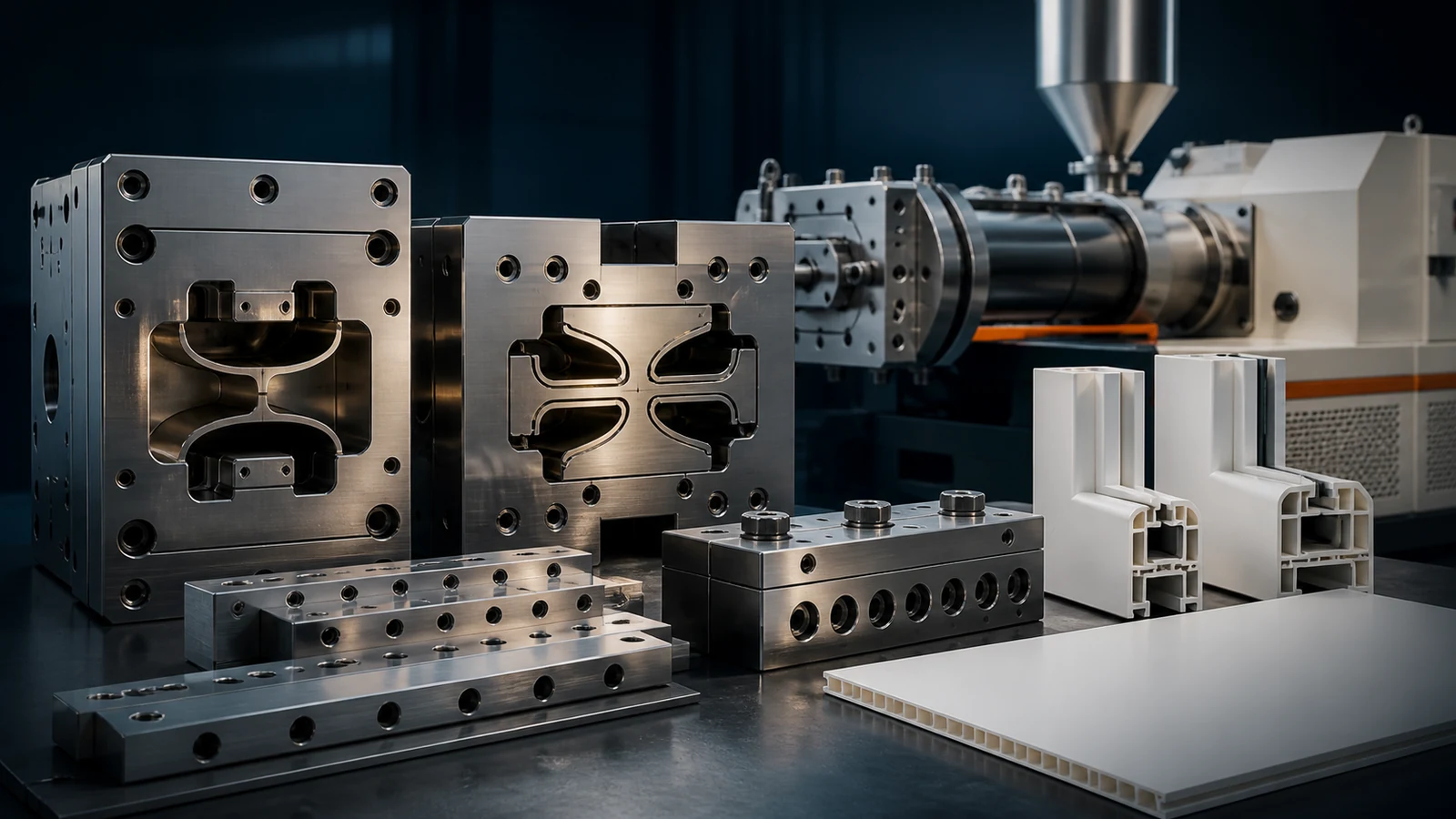
The extrusion die is the heart of any PVC profile or sheet production line. It transforms the cylindrical melt from the extruder into the desired cross-sectional shape, controls wall thickness distribution, and determines surface quality. A well-designed die can mean the difference between a profitable production line and one plagued by defects, downtime, and scrap.
This guide covers the fundamental principles of PVC die design — from flow channel geometry to calibration — with practical insights for profile extrusion and sheet/board extrusion applications.
1. Die Design Fundamentals
PVC extrusion dies must account for the unique rheological properties of PVC melt:
- High melt viscosity: PVC is one of the more viscous thermoplastics, requiring robust die construction
- Shear sensitivity: Excessive shear causes melt fracture and surface defects
- Thermal sensitivity: PVC degrades at high temperatures — the die must maintain uniform temperature distribution
- Die swell: PVC melt expands 10-30% upon exiting the die, requiring the die opening to be smaller than the target dimensions
- Drawdown: The melt stretches between the die and calibrator, affecting final dimensions
2. Flow Channel Design
The flow channel inside the die guides the melt from the circular extruder output to the target cross-section. The design must ensure uniform flow velocity across the entire cross-section.
Key Design Principles
a) Smooth Transitions
All transitions in the flow channel must be gradual and streamlined. Sharp corners or sudden changes in cross-section cause:
- Stagnation zones where PVC degrades
- Uneven flow distribution
- Flow lines visible on the product surface
b) Compression Ratio
The compression ratio is the ratio of the cross-sectional area at the die inlet to the area at the die land (exit). For PVC profiles, the compression ratio typically ranges from 2:1 to 5:1.
- Low compression (2:1-3:1): Suitable for simple profiles and soft PVC
- Medium compression (3:1-4:1): Standard for most rigid PVC profiles
- High compression (4:1-5:1): For complex profiles requiring excellent weld line strength
Higher compression improves melt homogeneity and weld line strength but increases back-pressure on the extruder.
c) Land Length
The land is the final parallel section of the die where the melt is shaped to the target cross-section. Land length affects dimensional stability and surface quality.
For PVC extrusion, the land length-to-thickness ratio (L/t) should be:
- Profiles: L/t = 15:1 to 30:1
- Sheets: L/t = 30:1 to 50:1
- Thin sections: Longer land for better flow distribution
- Thick sections: Shorter land to prevent excessive back-pressure
The land length must be proportional to the wall thickness. A common mistake is using uniform land length across a profile with varying wall thicknesses — this causes uneven flow and dimensional variation.
d) Distribution Channel (Manifold)
For sheet and board dies, a distribution channel (manifold) system ensures uniform melt distribution across the width. The most common design is the coat-hanger manifold, which uses a teardrop-shaped channel that narrows from center to edges.
Key manifold design parameters:
- Manifold volume: Should decrease from center to edge to compensate for flow path length differences
- Land length variation: Shorter at center, longer at edges to equalize flow resistance
- Manifold radius: Typically 10-20 mm at center, tapering to 3-5 mm at edges
3. Profile Die Design
PVC profile dies are significantly more complex than sheet dies because they must produce specific cross-sectional shapes — window profiles, wall panels, ceiling panels, corner beads, etc.
Die Plate Structure
A typical profile die consists of:
- Adapter plate: Connects the die to the extruder flange
- Transition section: Transforms the circular melt to a rough profile shape
- Pre-forming section: Gradually shapes the melt closer to the final profile
- Die land (forming section): Final parallel section that sets the exact dimensions
Wall Thickness Compensation
When a profile has sections of different thicknesses, the flow must be balanced by adjusting:
- Land length: Longer land for thin sections, shorter for thick sections
- Pre-distribution: Channel more melt toward thick sections
- Flow restrictors: Localized flow resistance in the transition section
Hollow Section Design
For hollow profiles (like window profiles), the die must include internal mandrels supported by spider legs or a spiral mandrel distribution system:
- Spider die: Simpler, less expensive, but creates weld lines where melt flows rejoin
- Spiral mandrel die: More expensive but eliminates weld lines and provides better flow distribution
- Filter pack die: Uses a perforated plate to support the mandrel — good for medium-complexity profiles
Weld lines are a common defect in hollow profiles. To minimize them:
- Ensure sufficient compression after the spider section (compression ratio > 3:1)
- Maintain high melt temperature at the rejoining point
- Use longer land length to allow weld lines to heal
4. Sheet and Board Die Design
For PVC sheet and board extrusion, the die is a flat T-die (or fishtail die) that distributes the melt across the full width.
T-Die Types
- Coat-hanger die: Most common for PVC sheets. Provides uniform flow across widths up to 2500 mm.
- Fishtail die: Simpler design, suitable for narrow sheets (< 600 mm)
- Manifold die with choker bar: Includes adjustable choker bars for flow distribution control during operation
Flex Lip Design
Modern sheet dies feature a flexible lip that can be adjusted during operation to fine-tune thickness distribution across the width. Adjustment bolts (typically spaced 25-50 mm apart) allow operators to locally compress or open the die gap.
Die Gap Setting
The die gap should account for die swell and drawdown:
- Target thickness × (1 + die swell %) = approximate die gap
- For PVC: die swell is typically 15-25%
- Example: For a 3 mm sheet with 20% swell → die gap ≈ 3.6 mm
Need a Custom Die for Your Profile?
We design and manufacture custom extrusion dies for any PVC or WPC profile shape. Get a die designed for your exact product specifications.
Request Die Design5. Vacuum Calibration
After the melt exits the die, it must be cooled and shaped to final dimensions. Vacuum calibration is the primary method for PVC profiles.
How Vacuum Calibration Works
- The hot melt enters a metal calibrator (usually brass or aluminum) shaped to the final profile dimensions.
- Vacuum is applied through small holes in the calibrator walls, pulling the melt against the calibrator surface.
- Cooling water circulating through the calibrator rapidly cools and solidifies the PVC.
- The vacuum also holds the profile in the correct shape while it cools.
Calibration Design Parameters
- Calibration length: 400-1000 mm per stage, often 2-3 stages in series
- Vacuum level: 0.05-0.08 MPa (typical for PVC profiles)
- Cooling water temperature: 15-25°C
- Vacuum hole diameter: 0.5-1.5 mm (smaller for thin-walled profiles)
- Vacuum hole spacing: 10-30 mm depending on profile complexity
For Sheets and Boards
Sheet extrusion uses a three-roll calendar instead of vacuum calibration:
- Three chrome-plated steel rolls arranged in a stack
- The melt passes between the rolls, which control thickness and surface finish
- Roll temperature: 40-80°C (top roll hotter for surface quality)
- For foam boards: Celuka calibrator with vacuum as described in our foaming process guide
6. Die Material Selection
| Component | Recommended Material | Surface Treatment |
|---|---|---|
| Die body | 40Cr or 3Cr13 stainless steel | Chrome plating (0.03-0.05 mm) |
| Flow channel surfaces | 3Cr13 or 9Cr18Mo | Mirror polish (Ra < 0.2 μm) |
| Calibrator | Brass (H62) or aluminum alloy (6061) | Chrome plating or hard anodizing |
| Heater bands | Cast aluminum with ceramic insulation | — |
Key material considerations:
- Corrosion resistance: PVC can release HCl at high temperatures — stainless steel prevents corrosion
- Surface finish: Mirror-polished flow channels reduce friction and improve surface quality
- Thermal conductivity: Brass calibrators cool faster than steel, improving production speed
- Wear resistance: For WPC extrusion, harden die surfaces to resist wood fiber abrasion
7. Common Die Defects and Solutions
| Defect | Cause | Solution |
|---|---|---|
| Uneven wall thickness | Poor flow distribution in die | Adjust land length, add flow restrictors |
| Weld lines (hollow profiles) | Insufficient compression after spider | Increase compression ratio, raise melt temp |
| Shark skin / melt fracture | Excessive shear stress at die exit | Reduce output, increase die gap, raise die temp |
| Die build-up (plate-out) | Lubricant migration to die surface | Adjust lubricant balance, clean die regularly |
| Dimensional instability | Inconsistent melt temperature | Check heater zones, improve temperature control |
| Poor surface finish | Rough die surface or low die temp | Polish die land, increase die temperature |
| Profile warping | Uneven wall thickness cooling | Balance calibrator cooling, adjust die flow |
8. Die Maintenance Best Practices
- Cleaning: Clean the die immediately after stopping production while PVC is still soft. Never use metal tools that scratch the surface.
- Storage: Apply anti-corrosion oil and store in a dry, dust-free environment.
- Inspection: Check for wear, especially at the die land, every 3-6 months.
- Resurfacing: Re-polish and re-chrome the flow channel every 1-2 years depending on usage.
- Spare parts: Keep spare heater bands, thermocouples, and calibration plates.
Related Products
This die design guide applies to all our extrusion lines, including:
- PVC Window Profile Machine — Complex hollow profile die
- Celuka Foam Board Machine — Special Celuka die + calibrator
- WPC Decking Machine — Wear-resistant die for wood fiber compounds
Conclusion
Die design is both a science and an art. While computational fluid dynamics (CFD) simulation has made the process more predictable, decades of practical experience still play a crucial role in producing dies that perform well in production. The key principles — smooth transitions, proper compression, balanced land length, and precise calibration — remain the foundation of every successful PVC extrusion die.
For more technical insights, explore our articles on PVC formulation and extruder selection. If you need a custom die designed for your specific profile, contact our engineering team.