
PVC Lamination & Hot Stamping Guide: Inline Surface Finishing
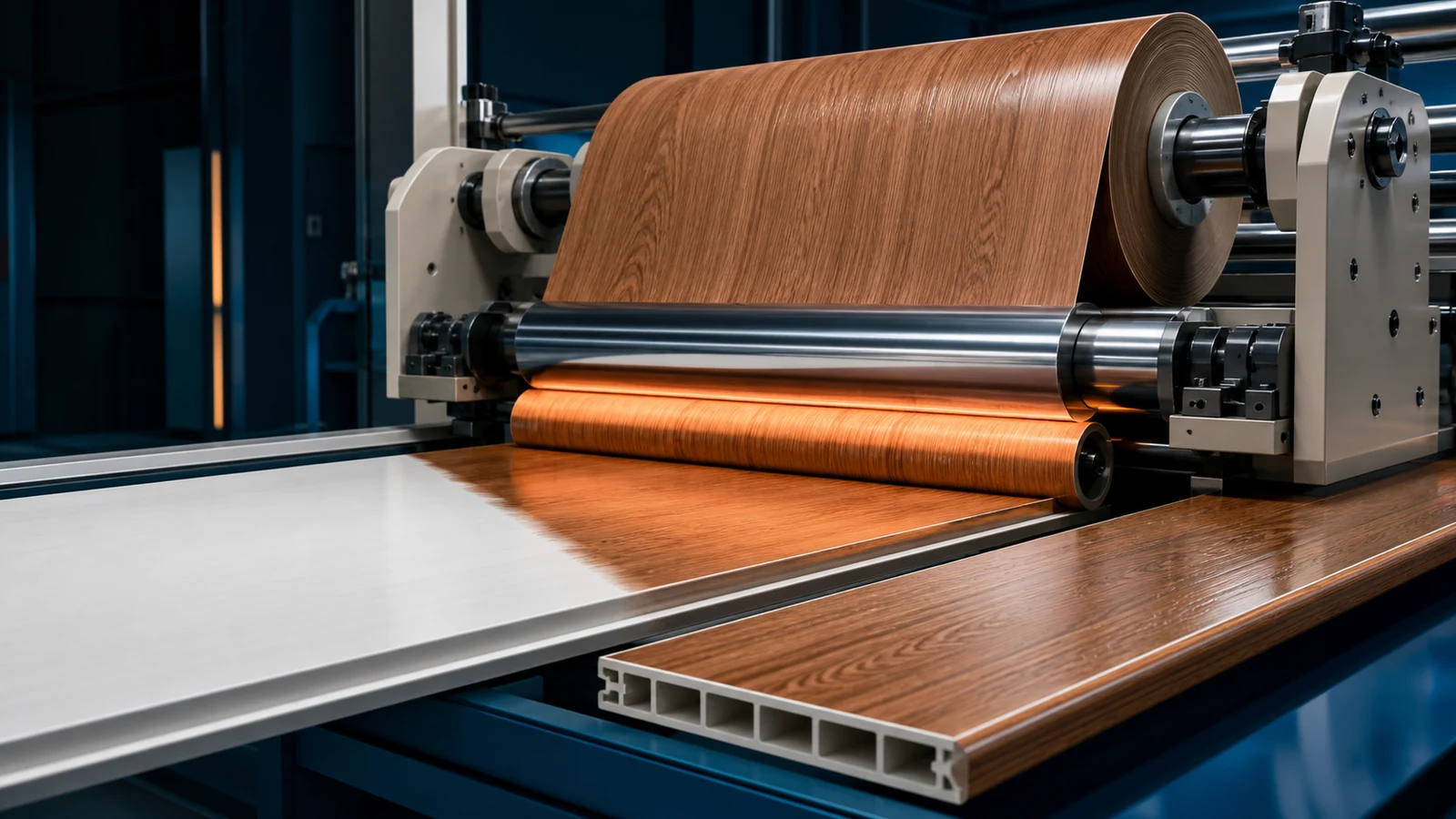
Not every PVC product can—or should—rely on pigmented compound for its appearance. Lamination (applying decorative films) and hot stamping (transferring metallic or patterned foils) open up design possibilities that coloring alone cannot achieve: realistic wood-grain on window profiles, metallic finishes on edge banding, and high-end decorative surfaces on door frames. This guide covers both processes in depth—from film selection to process parameters to common defects.
1. PVC Lamination: Applying Decorative Films
Lamination bonds a decorative film to the PVC profile surface using heat, pressure, and adhesive. The process can be inline (integrated with the extrusion line) or offline (post-extrusion), with inline being more economical for high-volume production.
Film Types for PVC Profiles
| Film Type | Thickness | Applications | Advantages | Limitations |
|---|---|---|---|---|
| PVC decorative film | 80–200 μm | Window profiles, door frames, wall panels | Same base polymer as substrate; excellent bond; wide color/pattern range | Lower UV resistance than acrylic; may require top-coat for outdoor use |
| Acrylic (PMMA) film | 50–100 μm | Premium window profiles, outdoor applications | Superior UV/weather resistance; high gloss; scratch-resistant | Higher cost (2–3x PVC film); more difficult to bond (needs special adhesive) |
| PET film | 12–50 μm | Edge banding, furniture trim | High clarity/gloss; good chemical resistance; recyclable | Bond to PVC requires tie-layer or adhesive; lower heat resistance |
| PP film | 50–120 μm | Furniture profiles, decorative trim | Low cost; good chemical resistance; lightweight | Poor UV resistance; difficult to bond to PVC (requires corona treatment) |
| Wood veneer (real wood) | 200–600 μm | Premium door frames, luxury profiles | Authentic wood appearance; premium market appeal | Expensive; delicate handling; moisture sensitivity; requires PU adhesive |
Adhesive Systems
The adhesive is the bridge between film and profile. Three systems dominate:
- Hot-melt PUR (Polyurethane Reactive): Industry standard for PVC profile lamination. Applied at 120–140°C, moisture-cures to form a cross-linked bond. Excellent adhesion, heat resistance (up to 90°C), and flexibility. Cost: moderate.
- EVA hot-melt: Lower cost but lower heat resistance (softens at 60–70°C). Acceptable for indoor profiles not exposed to direct sunlight. Cost: low.
- Solvent-based acrylic/ PU adhesive: Strongest bond but requires drying tunnel and solvent management. Used for premium/outdoor applications where PUR alone is insufficient. Cost: high.
For 90% of PVC profile lamination, PUR hot-melt is the right choice. It provides an excellent balance of bond strength, processing speed, and heat resistance. The premium over EVA is typically US$0.10–0.20 per linear meter, which is negligible compared to the value added by lamination.
2. Lamination Process Steps & Parameters
Inline Lamination Line Layout
- Profile pre-heating: IR heaters or hot-air blowers bring the profile surface to 50–70°C. Pre-heating improves adhesive wet-out and bonding.
- Adhesive application: Slot-die coater or roller applies a uniform 50–80 g/m2 layer of hot-melt adhesive to the profile surface. PUR requires an enclosed system with nitrogen blanketing to prevent premature moisture curing.
- Film feeding & alignment: Film is unwound from a roll, tension-controlled, and guided onto the adhesive-coated profile. Edge guides maintain ±0.5 mm alignment.
- Pressure lamination: A series of silicone or rubber pressure rollers (durometer 60–70 Shore A) press the film onto the profile at 0.2–0.5 MPa. The profile wraps around curved sections using compliant rollers.
- Cooling: Air cooling or chilled rollers set the adhesive and stabilize the bond.
- Edge trimming (if needed): Rotary knives remove excess film from edges.
Critical Parameters
| Parameter | PVC Film | Acrylic Film | PET Film |
|---|---|---|---|
| Profile surface temp (at lamination) | 55–65°C | 60–75°C | 55–65°C |
| Adhesive temp (PUR) | 125–140°C | 130–145°C | 120–135°C |
| Adhesive coat weight | 50–70 g/m2 | 60–80 g/m2 | 50–70 g/m2 |
| Roller pressure | 0.2–0.4 MPa | 0.3–0.5 MPa | 0.2–0.4 MPa |
| Line speed | 5–25 m/min | 3–15 m/min | 5–20 m/min |
| Film tension | 20–40 N | 25–50 N | 15–30 N |
3. Hot Stamping (Foil Transfer)
Hot stamping transfers a thin layer of metallic, pigmented, or patterned material from a carrier film (PET) onto the PVC surface using a heated silicone die under pressure. Unlike lamination, which applies a continuous film, hot stamping transfers only the pattern area—ideal for logos, decorative stripes, and selective metallic accents on edge banding and profiles.
Hot Stamping Foil Construction
A hot stamping foil is a multi-layer structure on a PET carrier:
- Carrier film (12–25 μm PET): Temporary support, removed after transfer
- Release layer: Wax-based, melts at stamping temperature to separate the decorative layers from the carrier
- Lacquer/color coat (1–3 μm): Provides color, pattern, or tint
- Metallization layer (optional, 30–50 nm aluminum): Creates the metallic finish by vacuum deposition
- Adhesive/size coat (1–2 μm): Heat-activated adhesive that bonds to the PVC surface
Hot Stamping Process Parameters
| Parameter | Recommended Range | Effect of Too Low | Effect of Too High |
|---|---|---|---|
| Die temperature | 140–180°C | Incomplete transfer; patchy coverage | Foil scorching; adhesive degradation; profile surface damage |
| Dwell time | 0.5–2.0 seconds | Incomplete transfer | Heat damage to profile; slower production |
| Stamping pressure | 0.5–1.5 MPa | Poor adhesion; incomplete contact | Crushed profile details; excessive foil spread beyond pattern edge |
| Silicone die hardness | 60–80 Shore A | Inadequate conformity to curved surfaces | Excessive deformation; short die life |
The most common hot stamping mistake is overheating. Above 190°C, most PVC compounds soften excessively, and the hot stamping die can deform the profile cross-section. Start at 150°C and increase in 5°C increments until full transfer is achieved.
4. Online vs Offline Lamination
| Aspect | Inline (Online) Lamination | Offline Lamination |
|---|---|---|
| Capital investment | Integrated into extrusion line (~US$10,000–20,000 adder) | Standalone laminating machine (~US$15,000–40,000) |
| Production efficiency | Single-pass: extrude + laminate in one step | Two-pass: extrude, store, then laminate. Extra handling cost |
| Line speed constraint | Lamination speed must match extrusion speed | Independent; can run faster or slower |
| Profile temperature | Utilizes residual heat from extrusion (saves energy) | Requires re-heating (adds energy cost) |
| Flexibility | Limited: changing film type/pattern requires stopping the line | High: quick changeover between film types and patterns |
| Quality control | Harder to inspect; defects impact entire production | Pre-inspection of profiles before lamination reduces waste |
| Best for | High-volume, single-pattern production (e.g., white wood-grain window profiles) | Multi-SKU production, short runs, premium products |
5. Common Lamination & Hot Stamping Defects
| Defect | Cause | Solution |
|---|---|---|
| Film peeling / delamination | Insufficient adhesive; profile too cold; adhesive temperature too low | Increase adhesive coat weight; raise profile pre-heat temp; check PUR application temp |
| Bubbles/blisters under film | Trapped air; moisture on profile surface; adhesive outgassing | Increase roller pressure; ensure profile is dry; use grooved pressure rollers to evacuate air |
| Wrinkles in film | Film tension too low; misalignment; profile twisting | Increase film tension; check edge guides; verify profile straightness from die |
| Film edge lift/flaking | Adhesive not covering edges; film wider than adhesive application | Extend adhesive application width; increase edge roller pressure; check film width matches profile |
| Incomplete hot stamp transfer | Temperature too low; dwell time too short; pressure insufficient | Increase die temp by 5–10°C; extend dwell time; check silicone die matches profile contour |
| Foil sticking to silicone die | Die temperature too high; wrong release layer on foil | Reduce die temp; verify foil specification (PVC-compatible release); clean/replace silicone die |
| Metallic finish appears dull | Die temperature too low; moisture on foil or profile; oxidized foil | Increase stamping temp; store foil in dry conditions (<50% RH); use fresh foil |
| Color fade after UV exposure | Wrong film grade for outdoor use; insufficient UV stabilizers in film | Use acrylic or UV-stabilized PVC film for outdoor applications; apply UV-cure clear top-coat |
6. Hot Stamping on Edge Banding: A Special Case
PVC edge banding is a major hot stamping application. The narrow width (15–60 mm) and thin cross-section (0.4–3.0 mm) require special considerations:
- Backing support is critical: The thin edge banding strip must be fully supported under the stamping die to prevent deformation. Use a contoured backing plate matching the edge banding profile.
- Temperature window is narrower: Thin material heats through faster; if die temperature exceeds 170°C, the edge banding itself can deform. Use lower temperature (140–160°C) with slightly longer dwell.
- Continuous rotary stamping: For edge banding, rotary hot stamping (heated roller with pattern, rather than flat die) enables continuous production at 10–30 m/min. This is the standard for edge banding manufacturing.
Need Lamination or Hot Stamping Equipment?
We supply PVC extrusion lines with integrated inline lamination and hot stamping stations, plus standalone finishing equipment.
Request Equipment InfoRelated Articles & Products
- WPC Surface Treatment: Embossing & Sanding
- PVC Die Design for Profiles and Sheets
- PVC Formulation Guide for Profile Extrusion
- Products: PVC Window Profile Machine | PVC Edge Banding Machine | PVC Door Frame Machine | PVC Wall Panel Machine
Conclusion
Surface finishing through lamination and hot stamping transforms commodity PVC profiles into differentiated, higher-margin products. The key decisions are: inline vs. offline (volume-dependent), film type (application-dependent), and adhesive system (performance-dependent). Most manufacturers start with inline PUR lamination using PVC decorative film for their core products, then add offline hot stamping capacity for premium SKUs. The investment typically pays back within 6–12 months through the 15–30% price premium that finished profiles command over plain white equivalents.