
WPC Coupling Agent Selection Guide: MAPP, MAPE & Silane
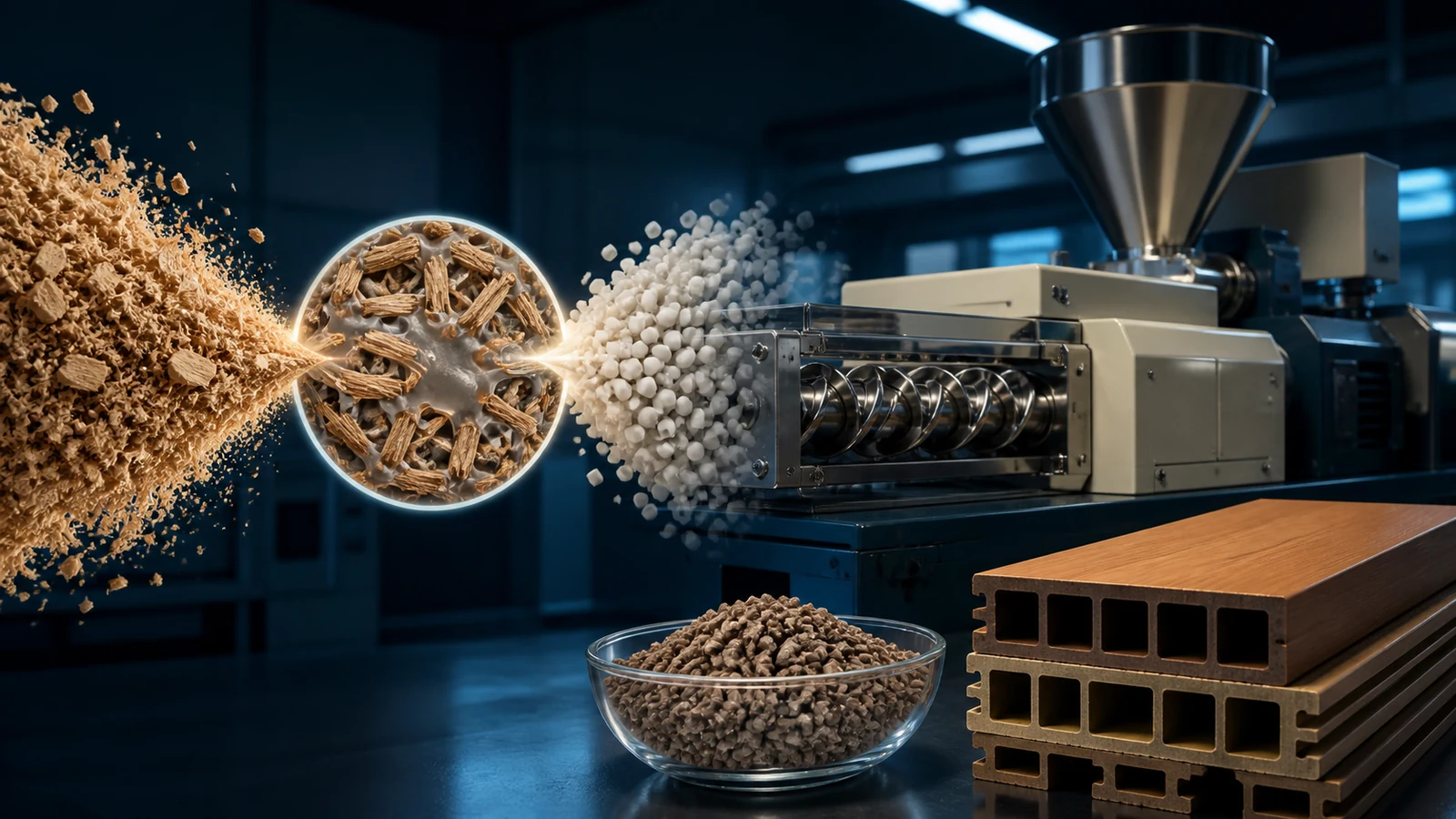
Wood and plastic don't naturally bond. Wood fibers are hydrophilic (water-loving), rich in hydroxyl (-OH) groups on cellulose and lignin. Thermoplastics like PE, PP, and PVC are hydrophobic (water-repelling). Without a coupling agent, the wood-plastic interface is a plane of weakness—like mortarless bricks stacked together. This is why WPC without coupling agents has 30–50% lower strength than it should.
Coupling agents bridge this gap. A well-chosen coupling agent at the right dosage can double the flexural strength and triple the impact resistance of WPC decking, WPC doors, and WPC wall panels. This guide breaks down the chemistry, selection criteria, and practical usage of the three main coupling agent families.
1. How Coupling Agents Work: The Molecular Bridge
All coupling agents for WPC follow the same principle: a bifunctional molecule with one end that reacts with wood fiber hydroxyl groups and another end that entangles with or bonds to the polymer matrix. This creates a continuous load-transfer path across the interface.
The three families differ in their polymer-compatible end:
- MAPP (Maleated Polypropylene): PP-compatible chain — for PP-based WPC
- MAPE (Maleated Polyethylene): PE-compatible chain — for PE-based WPC
- Silanes: Organofunctional silane with vinyl, amino, or mercapto groups — for PVC-based WPC and specialty applications
2. MAPP: Maleated Polypropylene
Chemistry
MAPP is polypropylene (PP) grafted with maleic anhydride (MAH), typically at 0.5–2.0 wt% MAH content. During compounding at 170–200°C, the anhydride groups react with wood fiber hydroxyls to form ester linkages, while the PP backbone co-crystallizes with the PP matrix.
When to Use MAPP
- Matrix polymer: PP (polypropylene) or PP-dominant blends
- MAH content: 0.8–1.5% for general WPC; 1.5–2.5% for high wood loading (>50%)
- Melt flow index (MFI): 50–150 g/10 min (190°C, 2.16 kg). Higher MFI = better wet-out of wood fibers, but too high reduces mechanical properties.
- Optimal dosage: 2–5% by weight of total compound (2–5 parts per 100 parts compound)
Performance Data (40% wood flour in PP, 3% MAPP)
| Property | Without Coupling Agent | With 3% MAPP | Improvement |
|---|---|---|---|
| Flexural strength | 28–35 MPa | 48–58 MPa | +65–70% |
| Flexural modulus | 2.5–3.0 GPa | 3.8–4.5 GPa | +50% |
| Tensile strength | 18–22 MPa | 28–35 MPa | +55–60% |
| Unnotched Izod impact | 60–80 J/m | 120–180 J/m | +100–125% |
| Water absorption (24h) | 2.5–3.5% | 0.8–1.5% | −55–65% |
MAPP is the most cost-effective coupling agent for PP-WPC at US$2.50–4.00/kg. At 3% loading, it adds approximately US$0.08–0.12/kg to compound cost while doubling impact strength—one of the highest ROI additives in WPC.
3. MAPE: Maleated Polyethylene
Chemistry
MAPE is polyethylene (typically HDPE or LDPE) grafted with maleic anhydride. The mechanism is analogous to MAPP: MAH groups react with wood -OH groups, while the PE backbone entangles with the PE matrix.
When to Use MAPE
- Matrix polymer: HDPE, LDPE, or PE-dominant blends. HDPE is the most common matrix for structural WPC (decking, fencing).
- MAH content: 0.5–1.5% for HDPE-WPC. LDPE-based MAPE typically has higher MAH grafting efficiency.
- MFI: 2–20 g/10 min (190°C, 2.16 kg) for HDPE-based MAPE. Lower MFI than MAPP because PE has higher melt viscosity.
- Optimal dosage: 2–5% for most PE-WPC; 3–5% for high wood loading (>60%)
HDPE-MAPE vs LDPE-MAPE
| MAPE Type | Advantages | Disadvantages | Best Application |
|---|---|---|---|
| HDPE-based MAPE | Better mechanical compatibility with HDPE matrix; higher heat resistance | Lower MAH grafting levels (0.5–1.0%); higher viscosity reduces fiber wet-out | Structural WPC (decking, fencing, load-bearing profiles) |
| LDPE-based MAPE | Higher MAH grafting (1.0–2.0%); better fiber wet-out; faster coupling reaction | Lower modulus; can reduce compound stiffness at higher loadings | Non-structural WPC (trim, molding, cladding); recycled PE matrices |
4. Silane Coupling Agents
Chemistry
Silane coupling agents have the general structure R-Si-(OR')3, where:
- R: Organofunctional group (vinyl, amino, methacryloxy, mercapto) that reacts with or is compatible with the polymer matrix
- OR': Hydrolyzable alkoxy groups (methoxy, ethoxy) that hydrolyze to silanol (Si-OH), which then condenses with wood fiber -OH groups
The two-step mechanism: (1) hydrolysis of alkoxy groups to silanols, (2) condensation of silanols with wood surface hydroxyls to form covalent Si-O-C bonds. The organofunctional R group then interacts with the polymer matrix.
Silane Selection by Polymer Matrix
| Polymer Matrix | Recommended Silane | Organofunctional Group | Dosage (wt% on wood) |
|---|---|---|---|
| PVC | Amino-silane (e.g., γ-APS / KH-550) | -NH2 (amino) | 0.5–1.5% |
| PVC (alternative) | Mercapto-silane (e.g., γ-MPS / KH-590) | -SH (mercapto) | 0.5–1.5% |
| PE | Vinyl-silane (e.g., VTMO / A-171) | -CH=CH2 (vinyl) | 1.0–2.0% |
| PP | Methacryloxy-silane (e.g., γ-MPS / KH-570) | Methacrylate | 1.0–2.0% |
| General (amino) | Amino-silane | -NH2 | 0.5–1.5% |
Why Silanes Are Preferred for PVC-WPC
MAPP and MAPE are ineffective in PVC-WPC because their PP/PE backbones are completely incompatible with PVC—they phase-separate and create a third weak interface. Silanes, by contrast, bond directly to both the wood and (through secondary interactions or co-reaction with PVC stabilizers/plasticizers) to the PVC matrix. Amino-silane (KH-550) is the industry standard for PVC-based WPC foam board and door frames.
Using MAPP in a PVC-WPC formulation is one of the most common mistakes we see. The PP backbone of MAPP is thermodynamically incompatible with PVC—it's like trying to glue wood and PVC with a polypropylene nail. Use silanes (amino-silane KH-550) or isocyanate coupling agents for PVC-based WPC.
5. Isocyanate Coupling Agents (PMDI)
Polymeric methylene diphenyl diisocyanate (PMDI) is a fourth option, primarily used in PVC-WPC. The -NCO groups react with wood -OH groups to form urethane linkages, while also potentially reacting with PVC degradation products (HCl) to form amides. PMDI provides excellent water resistance but requires careful handling (moisture-sensitive, respiratory irritant). Dosage: 0.5–2.0% by weight.
6. Coupling Agent Selection Flowchart
- Is your matrix PP? → Use MAPP (0.8–1.5% MAH, 2–5% dosage)
- Is your matrix PE (HDPE/LDPE)? → Use MAPE (0.5–1.5% MAH, 2–5% dosage)
- Is your matrix PVC? → Use amino-silane (KH-550, 0.5–1.5% on wood weight) or PMDI (0.5–2.0%)
- Is it a PE/PP blend or recycled mixed polyolefin? → Use MAPE (broader compatibility); consider a 50/50 MAPP/MAPE blend if PP content >30%
- Need maximum water resistance? → Consider PMDI for PVC; higher-MAH MAPE for PE
7. Optimizing Coupling Agent Dosage
Coupling agent efficiency follows a law of diminishing returns. The relationship between dosage and strength gain is asymptotic:
- 0–2%: Rapid strength increase as bare wood surfaces become covered
- 2–4%: Incremental gains as remaining uncovered sites are saturated
- >5%: Negligible improvement; excess coupling agent acts as plasticizer (MAPP/MAPE) or creates a weak interlayer (silane)
Optimal dosage depends on wood surface area, not compound weight. This means:
- Higher wood loading → proportionally higher coupling agent needed
- Finer wood powder (higher surface area) → higher coupling agent needed. 100-mesh wood powder has ~2x the surface area of 60-mesh and needs ~2x the coupling agent.
- Porous wood species (pine) need more coupling agent than dense species (oak, teak) at the same particle size.
Practical Starting Formulation for PE-WPC Decking
| Component | Loading (wt%) |
|---|---|
| HDPE (recycled or virgin) | 30–35% |
| Wood flour (80–100 mesh, moisture <1%) | 55–60% |
| MAPE coupling agent (1.0% MAH, HDPE-based) | 3–4% |
| Lubricant (zinc stearate / EBS blend) | 1.5–2.5% |
| Color masterbatch | 2–3% |
| UV stabilizer package | 0.5–1.0% |
8. Common Coupling Agent Mistakes
| Mistake | Consequence | Correction |
|---|---|---|
| Using MAPP with PVC matrix | No improvement; phase separation creates weak spots; worse properties than no coupling agent | Switch to amino-silane or PMDI for PVC-matrix WPC |
| Using MAPE with PP matrix | Weak PE-PP interface; only partial strength gain | Use MAPP for PP matrix; MAPE only for PE |
| Insufficient dosage (<1%) | Negligible property improvement | Minimum effective dosage is ~2% for MAPP/MAPE, ~0.5% for silane |
| Excessive dosage (>6%) | Wasted cost; possible plasticization; screw slippage | Cap at 5% for MAPP/MAPE; test incrementally from 2% upward |
| Not accounting for wood moisture | Water competes with coupling agent for -OH sites; reduced effectiveness | Pre-dry wood flour to <1% moisture before compounding |
| Adding coupling agent late in compounding | Uneven distribution; coupling agent doesn't reach all wood surfaces | Add coupling agent early—at the feed throat or first mixing zone—before significant shear heating |
Need Help with Your WPC Formulation?
Our application engineers can recommend the optimal coupling agent system for your specific WPC product and raw materials.
Get Formulation SupportRelated Articles & Products
- WPC Formulation: Wood Powder Ratio Guide
- WPC Surface Treatment: Embossing & Sanding
- Conical vs Parallel Twin Screw Extruder
- Products: WPC Decking Machine | WPC Door Machine | WPC Wall Panel Machine | WPC Fence Machine
Conclusion
Coupling agents are not optional in WPC—they are the difference between a composite that performs like a material and one that performs like a mixture. The selection rule is straightforward: match the coupling agent backbone to the matrix polymer (MAPP for PP, MAPE for PE, silane/PMDI for PVC). At 2–5% dosage, the added raw material cost (US$0.05–0.20/kg) is one of the best investments in WPC manufacturing, typically delivering 50–100% improvement in mechanical properties and 50–65% reduction in water absorption. The most expensive coupling agent is no coupling agent at all.